

7 Mukhi Rudraksha Benefits: Mahalakshmi, Saturn and a Steadier Approach to Money
Ask a family elder and the seven-faced bead is Mahalakshmi's; ask an astrologer and it is Saturn's. Both readings point the same way: towards money that is kept through patience, not money that arrives overnight.
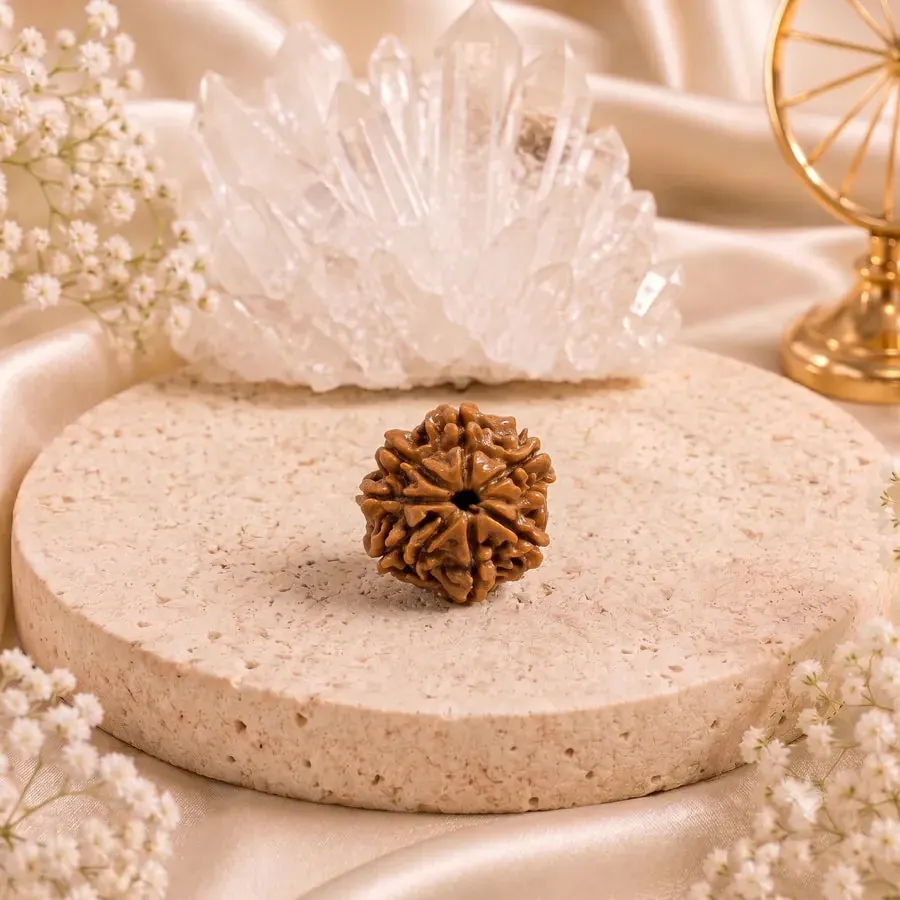
Ask a grandmother why she wears a seven-faced rudraksha and she may tell you it is Mahalakshmi's bead. Ask an astrologer and you are more likely to hear Shani's name, usually in the same sentence as Sade Sati. Both answers are right, and together they explain the 7 mukhi rudraksha benefits that tradition describes: prosperity on one side, endurance on the other, and between them a bead about money that is earned and kept rather than money that turns up suddenly.
The seed is recognised by its seven natural face lines (mukhi), grooves that run unbroken from one end to the other. In Hindi it is the saat mukhi rudraksha, in Sanskrit the sapta mukhi. Most people first put it on on a Saturday, with a short Shiva or Saturn mantra. Everything below is what the tradition says. A rudraksha does not put money in an account, clear a loan or end a difficult period; at best it is a daily reminder of the steadiness those things actually need.
Mahalakshmi's bead: where the prosperity reading comes from
Prosperity is the oldest layer. Texts that describe rudraksha by face count, such as the list usually quoted from the Shiva Purana, connect the seven-faced bead with wealth; the verse is commonly read as saying that even a poor person who wears it becomes prosperous. Who presides over the bead is less settled. Some lists name Ananga (Kamadeva), others the seven Matrikas or the seven sages, but the prosperity theme stays constant across them.
Household practice settled the question in its own way. Over time that theme attached itself to Mahalakshmi, and today many sellers and families simply call the 7 Mukhi her bead. Astroliya's own store listing follows the same usage, describing it as "traditionally associated with Goddess Mahalaxmi" and a symbol of "prosperity, stability, abundance and inner harmony".
Shani's bead: the Saturn link in astrology
The planet-by-mukhi scheme came later and belongs to astrology rather than to the Puranic lists. In its common version the seven-faced bead goes with Shani (Saturn), the planet of time, effort and slow results, and lord of Capricorn (Makara) and Aquarius (Kumbha). That is why Astroliya's Sade Sati explainer lists wearing a 7 Mukhi among the traditional Saturn practices, beside a sesame-oil lamp on Saturdays and service to elders and workers.
Sources that mention only one of the two links can look as if they disagree, but they are describing different layers. Astrologers who hold both usually reconcile them like this: Saturn rules results that are earned slowly and last, and Lakshmi, in household belief, stays where there is discipline and order. Taken together, the bead stands less for a windfall than for money that stays.
Who reaches for a seven-faced bead
This is not a general-purpose first bead. Astrologers and families tend to suggest it in fairly specific situations:
- A Capricorn or Aquarius Moon. These are Saturn's own signs, so the zodiac-based lists pair them with a Saturn bead. Our rudraksha by zodiac sign guide shows every pairing.
- Sade Sati or Saturn's dhaiya. Saturn is passing close to the natal Moon, and this is when Saturn remedies come up most. The Sade Sati explainer describes the three phases.
- A Saturn mahadasha or antardasha. The 19-year Shani period has its own guide: Shani mahadasha.
- Finances or work being rebuilt slowly. This is the Mahalakshmi side read honestly: someone paying down debt, building savings or running a small business that grows by inches. The bead is a symbol of patience, not a shortcut.
- Work that is long, repetitive or physical. Saturn is traditionally the planet of labour, service and persistence, so astrologers often suggest Saturn remedies for careers built that way. For other career aims, see which rudraksha is best for career growth.
An illustration, not a reading: picture an Aquarius Moon person in the last phase of Sade Sati who is also running Saturn's antardasha. An astrologer in this tradition might suggest a 7 Mukhi with the Shani beej mantra on Saturdays as a simple support for that stretch. For a Libra Moon person, who has neither Sade Sati nor dhaiya in 2027 and is not in a Saturn dasha, the same astrologer would probably see no particular astrological reason for it, though nothing in the tradition stops them wearing it.
7 mukhi rudraksha benefits for money: habits, not windfalls
Most writing about this bead goes wrong right here, so to put it plainly: the tradition links the 7 Mukhi with prosperity. It does not say the bead pays bills, wins lotteries, returns loans or rescues a failing business, and we will not say it either.
What the tradition does describe, in the words of Astroliya's listing, is "a stable approach to life". People who wear the bead for money usually pair it with a habit, and the habit is what changes things. Five that fit the Saturn-and-Lakshmi idea:
- A fixed Saturday review. Saturday is Shani's day. Spend part of it on the week's spending and the month's dues, before or after your mantra.
- One debt at a time. Saturn is slow and thorough. List what you owe and close the smallest or costliest first instead of juggling all of them.
- Savings you never touch. Small, regular and boring is the Saturn way, and Lakshmi, in household belief, stays where things are kept in order.
- Paying people on time. Saturn traditionally rules workers and service, and many families treat fair, timely payment to those who work for them as part of their Saturn practice.
- Real advice for real problems. A loan, tax or legal matter needs a qualified professional. The bead can sit beside that advice; it cannot replace it.
To read money from your own chart, astrologers traditionally look at the 2nd and 11th houses and their lords, and the wealth and money report reads them from your kundli. For the home side, our guide to vastu tips for money covers the locker, the north and what vastu cannot do.
Is Sade Sati actually running for you in 2027?
Plenty of 7 Mukhi beads are bought for a Sade Sati the buyer is not in. It depends on your Moon sign, not your Sun sign, so start by finding your rashi from a free kundli.
Saturn changes sign in 2027, which changes who is affected. According to the published transit tables we use, Saturn enters Aries on 3 June 2027, turns back into Pisces on 20 October 2027, and settles in Aries on 23 February 2028. Those dates come from a single published ephemeris source, so check them against your local panchang.
| Moon sign | What Saturn in Aries means | Note |
|---|---|---|
| Taurus (Vrishabha) | Sade Sati begins (first phase) | Pauses while Saturn is back in Pisces from 20 Oct 2027 |
| Aries (Mesha) | Peak phase, Saturn over the Moon sign | Continues |
| Pisces (Meena) | Last phase | Continues |
| Aquarius (Kumbha) | Sade Sati ends | Resumes briefly while Saturn is back in Pisces |
| Capricorn (Makara) | Saturn's dhaiya (4th from the Moon) | Not Sade Sati; pauses while Saturn is back in Pisces |
| Virgo (Kanya) | Saturn's dhaiya (8th from the Moon) | Not Sade Sati; pauses while Saturn is back in Pisces |
The sign-by-sign detail, including the back-and-forth around October, is in our Sade Sati 2027 guide. For your own dates and how they overlap with your dasha, the Sade Sati report reads them from your chart, or Astroliya's AI astrologer can check whether Saturn is active for you and show its reasoning.
Sade Sati is not seven and a half years of bad luck; many people marry, build careers and buy homes during it. Astrologers traditionally read it as a time of pressure, responsibility and slower results, which is exactly why a bead about patience keeps being suggested for it.
Saturday evening and the Shani beej mantra
Families and teachers differ on the details, so here are the common choices side by side.
| Question | Common practice | Where teachers differ |
|---|---|---|
| Day | Saturday, Shani's day | Monday, Shiva's day, if worn mainly as a Shiva bead |
| Time | Evening, after sunset, for Saturn | Morning after bathing is also common |
| Mantra | Shani beej mantra | Om Hum Namah, the mantra many rudraksha lists give for 7 Mukhi, or Om Namah Shivaya |
| Count | 108 repetitions, one mala | Start with 11 or 27 if 108 is too long |
| Thread | Black or red thread, or silver capping | Gold capping is also used |
Astroliya's mantra card gives the Shani beej mantra as:
The card suggests 108 repetitions on a Saturday, after sunset, sitting with the spine straight, and adds that any day is fine if that is when you can sit. You can listen and practise on the Astroliya mantra page; our guide to mantra japa rules explains counting on a mala.
A first wearing that many families follow:
- Rinse the bead in clean water (some use Ganga jal or raw milk first) and let it dry.
- On a Saturday evening, sit facing west or north, light a sesame-oil lamp if you wish, and hold the bead in your right hand.
- Recite your chosen mantra 108 times.
- Wear it around the neck so it rests near the chest, or on the wrist.
Many people take it off before sleeping, bathing with soap or swimming, though practice varies; a wipe with a dry cloth now and then is all the care it needs. If your family or guru gives a different day or mantra, follow theirs. The tradition puts more weight on regular practice than on any one formula.
Telling a natural saat mukhi from a carved one
Seven-faced beads turn up far less often than five-faced ones, which is what makes them worth faking. The usual trick is to cut extra grooves into a bead with fewer faces, so identification starts with the lines themselves.
Turn the bead slowly under good light and follow each groove from the stem end to the far end. A natural mukhi runs the whole length without a break, and you should be able to count seven. A line that stops short, looks freshly cut or shows a different colour inside the groove is a warning sign.
The surface only tells you so much, because a well-cut line can pass a casual look. An X-ray or CT image shows the seed chambers inside, and their number should match the face count. Our guide to certified rudraksha explains what such a certificate proves and what it does not.
Ignore the party tricks. Floating or sinking in water, spinning between two coins or changing the colour of milk say nothing about whether a bead is real. The tests worth trusting, and the ones that are not, are listed in how to identify original rudraksha.
The 7 Mukhi pendant on Astroliya's store
Astroliya's Certified 7 Mukhi Nepali Rudraksha Pendant is a natural Nepali bead with seven face lines, set as a pendant. The listing says it "comes with certification for authenticity" but does not name the testing method, so ask before you buy if the X-ray question above matters to you. It also notes that each natural bead has its own shape, texture, size and surface, so the one you receive will not look exactly like the photo. Other pendants are in the rudraksha pendants collection.
Saat mukhi rudraksha: what people ask
Which planet rules the 7 Mukhi rudraksha?
In the astrological mapping most astrologers use, the 7 Mukhi belongs to Saturn (Shani). The older Puranic lists do not use planets at all; they link the bead with prosperity and name different deities. Mahalakshmi is the association most people know today.
Can a 7 Mukhi rudraksha help with debt?
Not by itself. Tradition links the bead with prosperity and steadiness, and many people wear it while they work through a repayment plan, as a reminder to keep at it. Closing a debt takes a budget, income and, where needed, advice from a financial professional.
Should I wear a 7 Mukhi during Sade Sati?
It is one of the practices astrologers traditionally suggest during Sade Sati, along with the Shani mantra, a Saturday lamp and service to others. It is optional, and Sade Sati itself is not something to fear. First check whether you are in it from your Moon sign, then decide.
Can women wear a 7 Mukhi rudraksha?
Yes. Rudraksha is generally described as suitable for anyone, whatever their age, gender or rashi, and the 7 Mukhi has no separate rule. Some women remove beads during certain days by family custom; that is a household practice, not a rule in the texts.
Is saat mukhi the same as 7 Mukhi?
Yes. Saat mukhi (Hindi), sapta mukhi (Sanskrit) and seven mukhi are the same bead, one with seven natural face lines.
From the Astroliya store
Pieces for this guide
Chosen from our own store to go with what you just read.


