

Mantra Japa Rules: How to Do Japa Step by Step and Keep Count
Japa is simple: one repetition, one bead, 108 beads to a round. The few rules that tradition keeps are about attention, not superstition, and here is the reasoning behind each one.
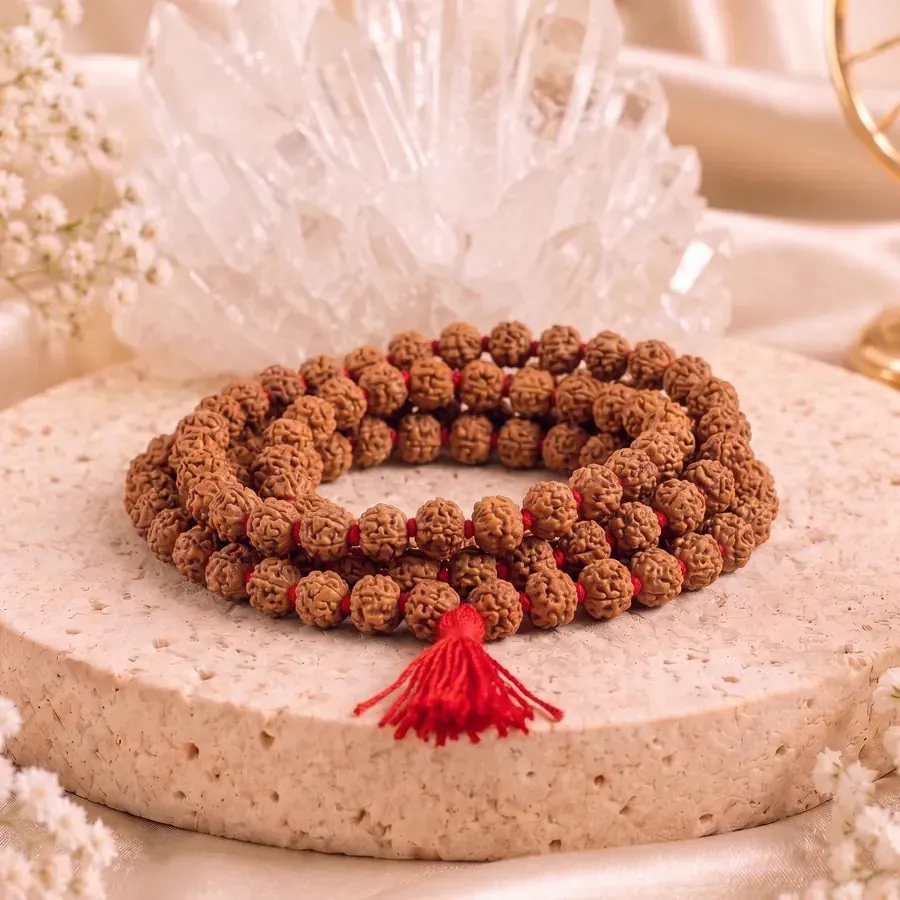
Japa means repeating a mantra with attention, usually counted on a mala of 108 beads. The mantra japa rules that Hindu tradition passes down are few, and most of them exist for one reason: to keep your mind on the mantra instead of on the counting. This guide walks through how to hold a rudraksha mala, which finger moves the beads, what to do at the guru bead, how many repetitions to start with, and the traditional day and time for four common mantras, taken from the mantra cards in Astroliya's own mantra tool.
Nothing here is a test you can fail. Classical texts and family traditions differ in the details, and where they do, we say so.
Mantra japa rules at a glance
If you only read one section, read this one. These are the japa mala rules most traditions agree on:
- Sit steady. Cross-legged on a mat or upright on a chair, spine straight, breath slow. Eyes closed or resting on the floor ahead.
- Hold the mala in your right hand, draped over the middle finger (some traditions use the ring finger), roughly at the level of your heart.
- Move the beads with your thumb, pulling one bead towards you for each full repetition of the mantra.
- Keep the index finger off the mala. It is traditionally held away from the beads.
- Start next to the guru bead (sumeru) and never count it or cross it. When you reach it after 108, turn the mala around and go back the way you came.
- Chant aloud, in a whisper or silently. All three are traditional; choose what keeps you focused.
- Keep the mala off the floor and store it in a cloth bag or a clean box between sessions.
Everything else, such as the number of rounds, the day and the hour, is a matter of the mantra you chant and the time you actually have.
Why 108, and what the guru bead is for
The sumeru or guru bead is the extra bead where the strand is tied, often with a tassel. It marks the start and end of a round, is not counted, and tradition says not to pass over it, out of respect for the marker. When your thumb reaches it, turn the mala and begin the next round in the opposite direction. The side effect is practical: you know 108 is done without counting in your head.
Why the round is 108 beads, and what 108 versus 108+1 means on a listing, are covered in our 108-bead mala guide. For japa, all you need is a clear guru bead to turn at.
How to do japa, step by step
Here is how to do japa on a rudraksha mala, from the moment you sit down.
- Settle first. Take a few slow breaths before you pick up the mala. Tradition prefers a clean body and a quiet place, but a busy home is no reason to skip the practice.
- Set an intention. Say silently which mantra you will chant and how many rounds. In tradition this resolve is called a sankalpa. It can be as simple as "one mala of Om Namah Shivaya this morning".
- Find the starting bead. Place your thumb on the first bead beside the guru bead. That bead is your first count.
- One mantra, one bead. Chant the whole mantra once, then pull that bead towards you with your thumb so the next one arrives under it. Do not pull the next bead mid-mantra.
- Keep the pace even. Rushing to finish the round is the most common way attention slips. A slower round with the meaning in mind is closer to what japa is for.
- Turn at the guru bead. After the 108th bead, do not cross the sumeru. Turn the mala around and, if you are doing another round, begin again in the other direction.
- Close quietly. Sit for a moment in silence, then touch the mala to your forehead if that is your custom and put it away in its bag.
Which finger moves the beads, and why
In the commonly taught method the mala rests over the middle finger, the thumb moves the beads, and the index finger stays out of the way. The reasoning that is traditionally given is symbolic: the index finger is the pointing finger, associated with the ego, while the thumb is linked to the divine. Some lineages rest the mala on the ring finger instead. If a teacher in your family taught you one way, keep to it; both are traditional.
Aloud, whispered or silent
Tradition names three ways: aloud (vachika), in a whisper (upamshu) and silently (manasika). The silent form is called the subtlest but is the easiest to drift from, so many people begin aloud and let the voice soften.
Four mantras: count, day and time
These are the mantra cards from Astroliya's mantra tool. The Devanagari has been checked against the standard Vedic and Navagraha forms. The day and time are what tradition prefers, not conditions: the Mahamrityunjaya and Shani cards say plainly that any day you can sit is fine.
| Mantra | Full count | Starting count | Traditional day | Traditional time |
|---|---|---|---|---|
| Mahamrityunjaya | 108 (one mala) | 11 | Monday (Shiva) | Early morning, before sunrise |
| Gayatri | 108 (one mala) | 3, 11 or 27 | Any day; Sunday is favoured | Sunrise (also noon and sunset) |
| Shani beej | 108 (one mala) | 11 or 27 | Saturday (Shani) | After sunset; early morning also works |
| Om | 108, or 10 minutes | No set number; time it instead | Any day | Morning or evening |
Mahamrityunjaya mantra
ॐ त्र्यम्बकं यजामहे सुगन्धिं पुष्टिवर्धनम् उर्वारुकमिव बन्धनान्मृत्योर्मुक्षीय माऽमृतात्
Om Tryambakam Yajamahe Sugandhim Pushtivardhanam, Urvarukamiva Bandhanan Mrityor Mukshiya Maamritat. A verse from the Rig Veda (7.59.12): "We worship the three-eyed one, fragrant and nourishing all. As a ripe cucumber is freed from its vine, may we be freed from death, and not from immortality." It is traditionally chanted for healing, courage and peace of mind, and it is a prayer, not a treatment: keep any medical care going alongside it.
Gayatri mantra
ॐ भूर्भुवः स्वः तत्सवितुर्वरेण्यं भर्गो देवस्य धीमहि धियो यो नः प्रचोदयात्
Om Bhur Bhuvah Svah, Tat Savitur Varenyam, Bhargo Devasya Dhimahi, Dhiyo Yo Nah Prachodayat. From the Rig Veda (3.62.10): "We meditate on the radiant light of Savitr, the divine Sun; may it inspire our understanding." It is a long mantra, so a round of 108 takes far longer than a round of Om; plan your sitting around that.
Shani beej mantra
ॐ प्रां प्रीं प्रौं सः शनैश्चराय नमः
Om Praam Preem Praum Sah Shanaishcharaya Namah: "salutations to Shani, the slow-moving one." The beej (seed) sounds are not translated word by word; they are chanted for their sound. The short form, ॐ शं शनैश्चराय नमः (Om Sham Shanaishcharaya Namah), is easier for beginners. Astrologers traditionally suggest Saturn mantras during Sade Sati or Saturn's dhaiya, and the mantra tool can pick it for you when your own chart shows one of those periods.
Om
ॐ, chanted slowly as A-U-M with a moment of silence after each one. Let each Om last one slow out-breath. If counting feels like a distraction here, sit for 10 minutes instead.
Starting small: 11, 27 or 108
A full mala is the traditional unit, but every card above names a smaller starting count, and that is deliberate. A short round done with attention is worth more, in the tradition's own terms, than 108 rushed repetitions.
An illustration, not a prescription: say you want to take up the Mahamrityunjaya mantra on Monday mornings. In the first weeks you chant it 11 times, counting from the guru bead and stopping at the eleventh bead. Once that feels unhurried, you move to 27, a quarter of the mala. When 27 is comfortable, you complete the full round of 108. Nothing is lost by taking a month to get there.
A few counting conventions people often ask about:
- 11, 27 and 54 are common partial counts. 27 is a quarter of a mala and 54 is half.
- Several rounds: after each 108, turn at the sumeru and go back. Some people keep a separate count of rounds on their fingers or with a few grains of rice set aside.
Common mistakes, and what to do when you lose count
Most mistakes in japa are moments when attention slips, not broken rules.
| What happens | Why it matters | What to do |
|---|---|---|
| You cross the guru bead without noticing | The round loses its clear end point | Turn back at the sumeru and continue; no need to restart |
| You pull a bead mid-mantra | Count and chant fall out of step | Finish the mantra, then match the next bead to the next repetition |
| You race to finish the round | The mantra becomes background noise | Slow down and let the meaning come back into mind |
| You use the index finger | It goes against the commonly taught method | Rest the mala on the middle finger and use only the thumb |
| The mala touches the floor | Tradition treats the mala with care | Pick it up, touch it to your forehead if you like, and carry on |
If you lose count: do not panic, and do not start the whole round again out of worry. Most teachers suggest one of two things: continue from the bead under your thumb, trusting the mala over your memory, or, if you are truly unsure, add a few extra repetitions so you are certain you have covered the count you intended. This is one of the real advantages of a mala over counting in your head: the bead under your thumb remembers for you.
Choosing and caring for a japa mala
Rudraksha is the traditional mala for Shiva mantras such as Mahamrityunjaya, and it is widely used for others too. Many families keep a tulsi mala for Vishnu and Krishna mantras; if your family has such a custom, follow it.
For japa, the mala's job is simple: beads your thumb can move one at a time and a guru bead that tells you the round is done. Choosing bead size, 108 or 108+1 and knotting is covered in our guide to 108-bead rudraksha malas, and the rudraksha malas in the Astroliya store are compared there listing by listing. If you are drawn to a 5 mukhi mala, the 5 mukhi rudraksha guide explains what the tradition associates with it.
Care is simple: keep the mala dry and away from soap and perfume, wipe it with a soft dry cloth, and store it in a cloth bag. Many traditions treat a japa mala as a personal object that is not passed around, and some keep the mala used for japa separate from one worn around the neck.
Seasons for japa
Two festivals are traditionally linked with Shiva mantras and rudraksha japa. Many people take up a long Mahamrityunjaya or Om Namah Shivaya practice on the night of Maha Shivratri, which has the date and the four prahars of the night. The month of Sawan, with its Monday fasts, is the other traditional season for Shiva japa, and that guide lists every Sawan Somvar.
If you want to know which mantra your own chart points to, for example a Saturn mantra during Sade Sati, the mantra tool chooses one for signed-in readers and shows why. You can also ask Astroliya's AI astrologer, which explains its reasoning from your chart. Either way, a mantra is a practice, not a fix: it is no substitute for medical, legal or financial advice.
Questions people ask
Can I do japa without a mala?
Yes. The Shani card in our mantra tool says plainly that fingers work fine for counting, and that holds for any mantra, especially for 11 or 27 repetitions. A mala helps mainly with longer counts, because the guru bead tells you when 108 is done without counting in your head.
Is it wrong to cross the sumeru bead?
Tradition asks you not to, and the reason given is respect for the bead that marks the start and end of the round. If you cross it by accident, simply turn back and continue. It does not spoil the japa.
Which hand should I hold the mala in?
The right hand, in most traditions, with the mala over the middle or ring finger and the thumb moving the beads. If a family teacher showed you a different way, keep to what you were taught.
Do I have to chant on the traditional day and time?
No. Each of Astroliya's mantra cards gives a traditional day and time, such as Monday early morning for Mahamrityunjaya or Saturday after sunset for the Shani beej mantra, and both cards add that any day you can sit is fine. Regular practice at a time you can keep matters more than the perfect hour.
From the Astroliya store
Pieces for this guide
Chosen from our own store to go with what you just read.


