

Rudraksha Mala 108 Beads: Choosing Bead Size, 108 or 108+1, and Knotting
A listing that says only "108 beads" and never mentions a guru bead may give you 107 beads to count and one marker, or no marker at all. That is worth asking before you buy.
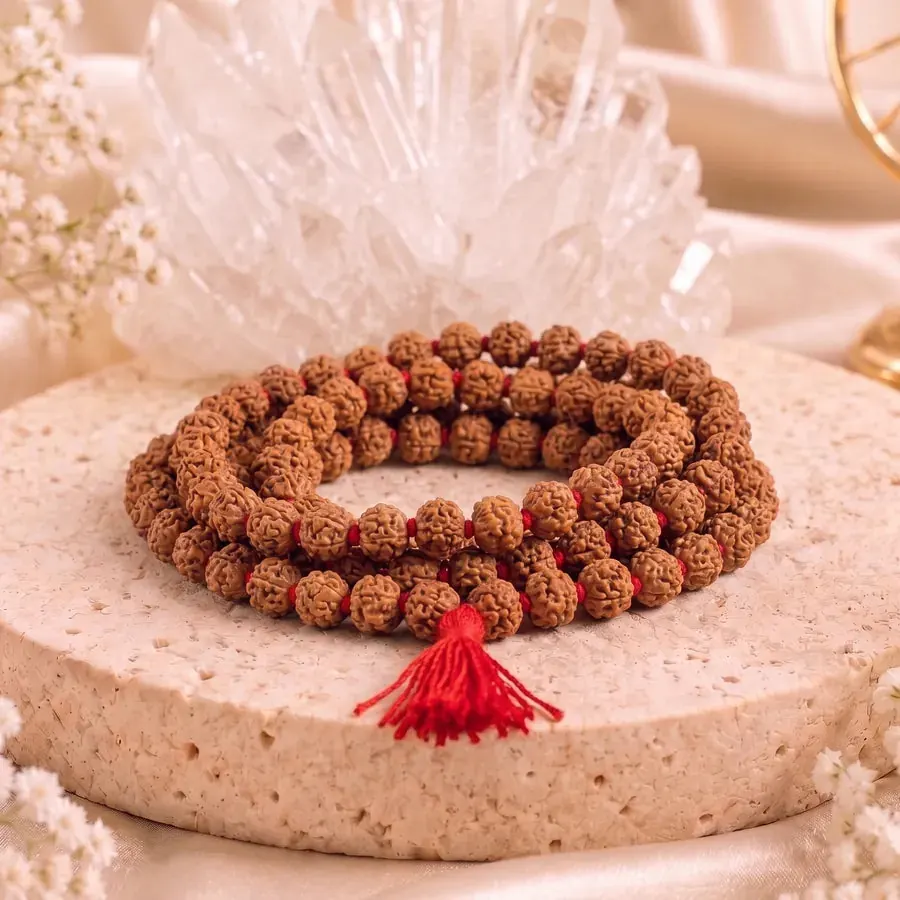
A rudraksha mala of 108 beads is the most common string of prayer beads in Hindu practice, and also one of the most confusing things to buy online. Search for a rudraksha mala 108 beads and two listings can look the same in a photo and feel quite different in your hand. Bead size changes how fast the strand moves under your thumb and how low it hangs if you wear it; knots between beads change how it handles and how it wears. The four malas stocked in the Astroliya store are compared at the end using only what each listing states.
How to actually count on the mala, which finger moves the beads and what to do at the guru bead, is covered in our guide to mantra japa rules. This page is the buying half of that story.
Rudraksha mala 108 beads: why 108, and what the +1 is
Tradition offers several reasons for 108, and teachers do not all give the same one. Two come from Vedic astrology and are easy to check: 12 rashis multiplied by 9 grahas is 108, and 27 nakshatras multiplied by 4 padas is also 108. Whatever the reason you prefer, the practical result is the same: one round of the mala is one complete unit of japa, long enough to settle the mind and short enough to repeat.
The +1 is the sumeru, also called the guru bead. It sits where the two ends of the string meet, often with a tassel, and it is not counted. It marks where a round begins and ends, and the common teaching is that you turn the mala at the guru bead instead of passing over it.
That gives you three possibilities when you read a listing:
- 108+1 means 108 counting beads plus a separate guru bead. This is the clearest option for japa.
- 108 with a separate guru bead mentioned in the description is the same thing, described differently.
- 108 with no guru bead mentioned is ambiguous. Either one of the 108 serves as the marker, leaving 107 to count, or there is no marker at all. Ask the seller before you buy if this matters to you.
None of this is about one mala being more sacred than another. A 108+1 mala is simply easier to count on, because your thumb finds the end of the round without your mind having to keep track.
Bead size: 8 mm or 9 to 10 mm
Rudraksha beads are natural seeds, so no two are identical, and listings give sizes as an approximate diameter. The size changes three things you will notice: how the beads feel under the thumb, how long the strand is, and how it sits if you wear it.
| What you notice | Smaller beads (around 8 mm) | Larger beads (around 9 to 10 mm) |
|---|---|---|
| Under the thumb | Light; moves quickly bead to bead | Each bead is easier to feel and separate |
| Long japa sessions | Less weight in the hand | A little heavier, but some find it steadier |
| Length of the strand | Shorter | Longer |
| Wearing round the neck | Sits more lightly | Bolder look, more weight |
| Seeing the mukhi lines | Harder at a glance | Easier |
To see why length changes, here is a rough calculation, offered only as an illustration: 108 beads of 8 mm laid end to end come to about 86 cm, and 108 beads of 10 mm come to about 108 cm, before you add knots, the guru bead or the tassel. A knotted mala is longer again, because each knot takes a little space. So a 9 to 10 mm mala is a long string; worn as a single loop it hangs well below the chest on most adults.
There is no rule that one size is correct for japa. If your hands are small, or you plan long sittings, an 8mm rudraksha mala is often the more comfortable choice. If you lose your place easily, or you find small beads slip past the thumb, larger beads give each repetition a clearer edge. If you have a choice, hold both before deciding.
The bead's origin also affects size. Larger beads with deeper mukhi lines are traditionally associated with Nepal and smaller, smoother ones with Indonesia; our guide to Nepali vs Indonesian rudraksha explains what actually differs and why the difference shows up in price.
Knotted or unknotted
A knotted mala has a small knot tied between every bead. An unknotted one has the beads strung directly against each other.
| Knotted | Unknotted | |
|---|---|---|
| Thumb movement | Each bead sits apart, so it is easy to move one at a time | Beads can bunch, so counting needs more care |
| Wear on the beads | Beads do not rub against each other | Beads rub, which can wear the surface over time |
| If the thread breaks | Usually only one or two beads come loose | All the beads can slide off at once |
| Length | A little longer | A little shorter |
| Upkeep | Knots can loosen and the thread can fray; restring when it does | Fewer parts to wear, but less margin when they do |
For a japa mala for meditation, knotting is the more forgiving choice: it slows the thumb just enough to keep one repetition per bead, and it protects the beads you have chosen. For a mala worn mainly as an ornament, it matters less.
Read listings carefully here. A product page that says "hand-knotted" or "knotted" is telling you. A product page that says nothing is not telling you either way, and the photograph may not be clear enough to judge. Ask the store if knotting matters to you.
Wearing it, or keeping it for japa
Many people wear a 108-bead mala, and many traditions keep a japa mala separate. Both are common, and which you follow is a matter of practice, not of right and wrong.
The reasoning behind keeping a japa mala apart is attention. A mala you count on becomes associated with the act of sitting down to chant; a mala worn all day becomes part of your clothing. Some families put it more strictly: the japa mala is personal, used only for japa, kept in a cloth pouch, and not lent to others.
If you want both, a common arrangement is a mala for japa at home and a single bead or a smaller piece for daily wear. Our 5 mukhi rudraksha guide compares a single bead, a mala and a bracelet for exactly this choice.
If you do wear a 108-bead mala, three practical points help:
- A long, heavy strand swings and catches. Tucking it under a kurta, or wearing it doubled, keeps the thread from straining.
- Water, soap and perfume are hard on the thread and the bead surface. Many people take the mala off before bathing.
- A worn mala gets more knocks than one kept in a pouch. Check the knots and the thread more often.
Caring for a rudraksha mala
Rudraksha is a dried seed, and the thread is cotton or silk in most traditional malas. Care is about keeping both dry and clean:
- Keep it dry. Wipe it with a soft dry cloth after use, especially if your hands were damp.
- Keep it away from chemicals. Soap, perfume, hair oil and cleaning products dull the surface and weaken the thread.
- Brush, do not scrub. If dust settles in the mukhi lines, a soft, dry brush lifts it out.
- Oil only if you choose to. Some families occasionally rub a little oil into the beads to stop them drying out; others never do. If you oil the beads, use very little and wipe off the excess so it does not soak the thread.
- Store it in a cloth bag. This keeps dust out and stops the beads knocking against other things.
- Watch the thread. When the knots loosen or the thread frays, have it restrung before it breaks.
None of this needs special products. If a seller says their mala needs a particular treatment to keep its qualities, that is a claim to ask about, not one to take on faith.
The four malas in the Astroliya store, compared
The Astroliya rudraksha malas collection holds four malas. The table below uses only what each listing states as of 27 October 2026. Prices change, so we leave them to the product pages, and certificate wording is quoted from each listing, not summarised across the range.
| Mala | Beads | Stated bead size | Knotting | Certificate wording |
|---|---|---|---|---|
| Certified 8mm Rudraksha Mala, 108+1 Hand-Knotted | 108+1 | 8 mm | Hand-knotted ("hand-tied with traditional knots") | "each mala comes certified" |
| 5 Mukhi Rudraksha Mala, Authentic 108+1 Bead Prayer Necklace | 108 plus one Guru bead | Approximately 9–10 mm | Not stated | "comes with a certificate of authenticity" |
| Astroliya Certified 5 Mukhi Rudraksha Mala (108 Beads) | 108 | Approximately 9–10 mm | Not stated | "comes with a certificate of authenticity" |
| Authentic 5 Mukhi Rudraksha Mala, 108 Beads for Meditation | 108 (in the title) | Not stated | Not stated | Its description is written for a single bead, which "comes with a certificate of authenticity" |
What the table tells you:
- Only one mala states it is knotted: the 8 mm 108+1 mala. Its listing does not state the mukhi of its beads, so if you want a specific mukhi, ask first.
- Two malas are 108+1: the 8 mm mala and the 5 mukhi prayer necklace. If you want a guru bead to mark the round, these are the two that say so.
- Two 5 mukhi malas state the same 9–10 mm size. Between them, the difference the listings state is the guru bead: the 108+1 necklace names one, while the Astroliya Certified mala lists 108 beads and does not mention a guru bead, so ask if you need one.
- One listing is incomplete. The Authentic 5 Mukhi Rudraksha Mala for Meditation has a description written for a single bead, so its bead size, guru bead and certificate details for the mala are unclear. Confirm them with the store before choosing it.
A certificate is a reference from the seller; what it covers depends on who issued it and what they tested. Our guide on how to identify original rudraksha explains which checks are useful and which popular tests are not.
A short way to decide
- What is it for? If you will count japa, you need a mala, and a guru bead helps. If you only want to wear rudraksha, a single bead may suit you better than 108.
- 108+1 or 108? For japa, prefer a listing that states a separate guru bead.
- What size suits your hand? Small hands or long sittings point towards 8 mm; a wish to feel each bead clearly points towards 9 to 10 mm.
- Knotted? For daily japa, yes if you can. If the listing does not say, ask.
- Which mukhi? 5 mukhi is the traditional everyday choice for japa. If you are unsure whether a mala is right for you at all, our decision guide works through goal, rashi and chart.
Two illustrations of how this plays out, not real customers:
- Illustration one. Someone starting a daily habit of 11 rounds of Om Namah Shivaya, with small hands, sitting for half an hour every morning. A knotted 108+1 mala in 8 mm fits: light in the hand, a clear guru bead, beads that stay apart.
- Illustration two. Someone who wants a 5 mukhi mala to wear at home and to chant on in the evenings, and who likes to see the five lines on each bead. A 9–10 mm 5 mukhi mala with a guru bead fits, with a cloth pouch for when it is not being worn.
Once you have a mala, the free mantra tool (sign-in needed) picks a mantra for the day from your chart and shows its Devanagari text, meaning, traditional count, day and time, with an on-screen mala counter for your rounds. Maha Shivratri, on 6 March 2027 per Drik Panchang (New Delhi; check your city), and the month of Sawan are the traditional Shiva seasons for japa; our Maha Shivratri guide has the night's timings.
Questions people ask
Is a 108+1 mala better than a 108-bead mala?
For counting japa, it is easier, because the extra guru bead marks the start and end of each round and is not counted. It is not more sacred or more powerful; it is just clearer to use. If you only plan to wear the mala, the guru bead matters less.
What size of rudraksha bead is best for a japa mala?
There is no single right size. An 8 mm mala is lighter and more comfortable for long sessions or small hands, while 9 to 10 mm beads are easier to feel one at a time and show their mukhi lines more clearly. Hold both if you can, and choose the one your thumb moves through comfortably.
Why does a knot between each bead matter?
The knot keeps the beads apart, so your thumb moves one bead at a time and the beads do not rub against each other. If the thread breaks, usually only one or two beads come loose instead of the whole strand. The trade-off is that knots can loosen over time and the mala needs restringing.
Can I wear the same mala I use for japa?
Many people do. Some traditions keep the japa mala separate and store it in a cloth pouch, so that it stays tied to the act of chanting. If your family follows such a custom, keep to it; if not, it is your choice.
How do I count on a 108-bead mala?
One repetition per bead, moving the beads with the thumb, and turning the mala at the guru bead instead of crossing it. Our guide to mantra japa rules walks through it step by step, with starting counts and four common mantras.
From the Astroliya store
Pieces for this guide
Chosen from our own store to go with what you just read.


