

How to Identify Original Rudraksha: Checks That Work, Tests That Don't
A genuine rudraksha can float and a fake can sink, so the water test settles nothing. The lines are what matter: each mukhi marks a seam between seed chambers inside, which is why a carved extra line shows up on an X-ray.
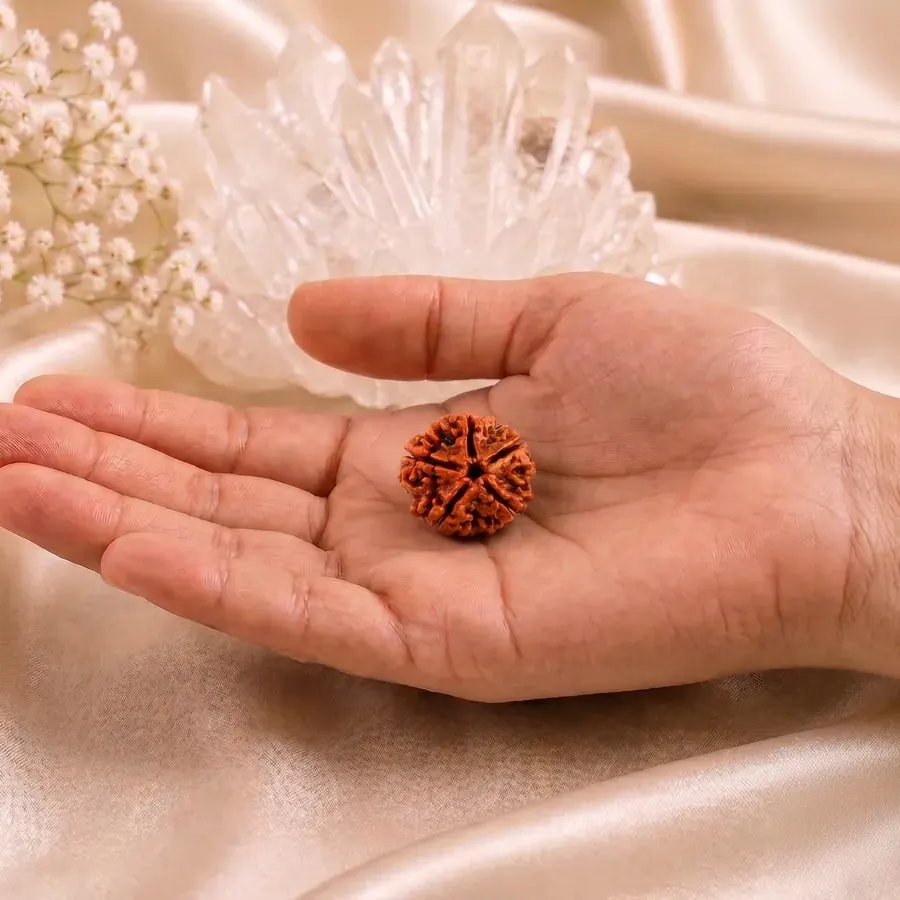
If you want to know how to identify original rudraksha, start by dropping the tests you have probably heard of. Floating a bead in water, spinning it between two copper coins or boiling it tells you very little, and boiling can ruin a genuine bead. What does help is slower and less dramatic: counting the lines from one end of the bead to the other, looking closely for carving, filler and joins, and, for the beads that are worth faking, an imaging report from a lab. For a costly bead the useful question is not whether it floats but who examined it, by what method, and whether their report matches the bead in your hand.
How to identify original rudraksha: the short answer
- Lines (mukhi) should run unbroken from one end to the other. A line that stops halfway, wanders, or has sharp, even tool edges is a warning sign.
- Look for filler and joins under magnification. Glossy paste in a groove, a seam around a "twin" bead, or patchy colour in the grooves all suggest work done after the seed left the tree.
- The water, coin and boiling tests prove nothing either way. Genuine beads can float and fakes can sink; anything oval spins between coins; boiling damages real beads.
- For costly beads, ask for an imaging report. A rudraksha x-ray test shows the seed chambers inside, which should match the lines outside.
- A certificate is only as good as its details. Who tested it, what method, and whether the photo matches the bead you receive.
How fake rudraksha is made
A rudraksha is the dried stone of the fruit of Elaeocarpus ganitrus. Each mukhi line on the surface marks a seam between the seed chambers inside, which is why the line count and the inside of the bead are linked. Fakes work by breaking that link, or by passing something else off as the real thing. The common methods are:
- Carved extra lines. A lower-mukhi bead, which is easier to find, gets one or two lines cut into it so it can be sold as a higher mukhi. The outside now shows more lines than there are chambers inside.
- Filled lines. The opposite trick: a groove is packed with paste or glue so a bead reads as fewer mukhis, usually to imitate a scarcer low count.
- Glued pairs. Two separate beads are stuck together and sold as a naturally joined Gauri Shankar, or extra pieces are glued on to make an unusual form.
- Dyed or polished beads. Colour and oil are used to hide carving, filler or a dull surface. Colouring alone is not fraud, because many sellers oil beads, but it can cover other work.
- Other seeds or moulded material. Similar-looking seeds, wood or resin are shaped to resemble rudraksha.
- Mislabelled origin. A bead from one region is sold as coming from another, because buyers will pay more for it. Imaging does not settle this; see Nepali vs Indonesian rudraksha for what actually differs.
The more a form costs, the more a fake is worth making. That puts 1 mukhi beads, Gauri Shankar pairs and the higher mukhi counts at the top of the list for careful checking.
Checks that help when telling real vs fake rudraksha
None of these is proof on its own, but together they catch most crude fakes, and you can do them with a phone camera or a cheap magnifying glass.
Count the lines pole to pole
Hold the bead with its two ends (the poles) facing up and down. Follow each line from the top opening to the bottom. In a natural bead the lines start and end at the poles and keep a steady, organic depth. A line that begins in the middle of the surface, stops short of a pole, or looks noticeably deeper and cleaner than its neighbours deserves a closer look.
Look for carving and filler
Natural grooves have the same bumpy, slightly irregular texture as the rest of the bead. Carved grooves tend to have straight walls and crisp edges, sometimes with tiny tool marks. Filler shows up as a smooth or shiny patch inside a groove, often a slightly different shade from the surrounding surface.
Look for joins
On a two-bead form, check where the beads meet. A natural pair shares a continuous surface at the join, with the texture running across it. A glued pair tends to show a seam, a thin line of adhesive or a step in the surface.
Look at the central channel
Many beads have a natural channel along the axis where the lines meet. Drilling is common and is not a sign of fakery by itself, since sellers drill beads to string them. But a hole that cuts across lines at an odd angle, or a bead that looks sealed at one pole and drilled at the other, is worth asking about.
Popular tests that prove nothing, and why
These are repeated so often that many buyers trust them more than anything else. Here is what each one actually measures.
| Test | The claim | What it really shows |
|---|---|---|
| Rudraksha water test (float or sink) | A real bead sinks, a fake floats | Only density. A dry bead or one with empty chambers can float; weighted resin or dense wood can sink. |
| Spinning between two copper coins | A real bead turns on its own | Small movements of the hands. Almost any oval object balanced between two coins will turn. |
| Boiling for hours | A fake falls apart, a real bead survives | It may separate a glued pair, but it can crack or dull a genuine bead. You risk the thing you were trying to check. |
| Colour rubbing off | Real beads never lose colour | Many sellers oil or colour genuine beads, so colour on a cloth says nothing about whether the seed is real. |
| Bead feels "warm" or gives "vibrations" | A real bead has energy you can feel | A personal impression, not a check. It cannot separate a carved bead from a natural one. |
The honest summary of the rudraksha water test and its cousins: a bead that passes them can still be carved, filled or glued, and a genuine bead can fail them.
The rudraksha x-ray test, and what a lab certificate can and can't tell you
Because each mukhi line sits over a chamber inside the seed, imaging is the one check that looks at both at once. An x-ray or similar scan shows the internal chambers, and a reader can compare their number with the lines on the surface. A bead whose lines and chambers match is far more likely to be natural; a bead with an extra surface line and no chamber beneath it has probably been carved.
What a good certificate can tell you:
- That a lab examined this particular bead, identified by a photo and usually its size or weight.
- The mukhi count it found, and whether the lines matched the inside on imaging.
- Whether it saw carving, filling or joining.
What it cannot tell you:
- Anything about spiritual effect. Classical texts describe what each mukhi is traditionally associated with; no lab measures that.
- Where the bead grew, unless the lab says how it decided. Imaging of the chambers does not by itself show a country of origin.
- That the bead in your hand is the one tested, unless the photo, size and weight on the certificate match it.
- That the lab is independent of the seller. Look for the lab's name and a way to check the report number.
For a fuller look at certificate wording and lab methods, read certified rudraksha: what a lab certificate proves.
Buying checklist before you pay
- Decide which bead you actually need first. Rudraksha is worn as a traditional practice and a reminder, not as a fix for health, money or marriage, and no bead can promise an outcome. Which rudraksha should I wear walks through that choice, and our guide to 1 mukhi rudraksha shows how much the stakes and the fakes rise with the rarer forms.
- Read the listing's exact certificate wording. "Lab tested", "certificate of authenticity" and "fully certified" are not the same claim. Ask which method was used.
- Ask who issued the certificate. You want a lab name and, ideally, a report number you can check.
- Ask whether imaging was done for 1 mukhi, Gauri Shankar and higher mukhi beads.
- Check the photo against the bead when it arrives. Count the lines, compare the shape and measure it if the certificate gives a size.
- Read the return policy before ordering, so you know what happens if the bead or its paperwork does not match.
- Be wary of extreme claims. A seller who promises results, or calls every bead rare and energised with nothing in writing, is selling a story.
How Astroliya documents its beads
We read every rudraksha listing on the Astroliya store on 27 October 2026 and copied the certificate wording each one uses. We are quoting the listings rather than summarising them, because the wording differs from bead to bead and the difference matters.
| Listing | Wording on the listing | What that tells you |
|---|---|---|
| Certified 1 Mukhi Round Nepali Rudraksha Pendant | "comes with certification for authenticity" | A certificate is included; the method and issuer are not stated on the page. |
| Natural 3 Mukhi Nepali Rudraksha Bead | "comes with a certificate of authenticity" | A certificate is included; ask who issued it. |
| Certified 4 Mukhi Nepali Rudraksha Bead | "comes with a certificate of authenticity" | As above. |
| Original 5 Mukhi Nepali Rudraksha Bead | "comes with a certificate of authenticity" | As above. |
| Certified 6 Mukhi Nepali Rudraksha Bead | "lab tested and comes with a certificate of authenticity" | A lab test is stated; the test type is not. |
| Certified 6 Mukhi Nepal Rudraksha Bead, Natural Brown Pendant | "carefully certified for authenticity" | Certification is stated; ask for the document's details. |
| Certified 7 Mukhi Nepali Rudraksha Pendant | "comes with certification for authenticity" | A certificate is included; method not stated. |
| Natural 8 Mukhi Rudraksha Bead | "comes with a lab certification for authenticity and identification" | A lab document identifying the bead is stated. |
| Certified Nepali 9 Mukhi Rudraksha Pendant | "fully certified to ensure its natural origin and quality" | The broadest wording; ask what was tested. |
| Natural Gauri Shankar Rudraksha Bead | "This bead is lab certified" | A lab certificate is stated; worth asking whether the join was imaged. |
| Certified 8mm Rudraksha Mala, 108+1 | "each mala comes certified" | The mala is certified; ask whether that covers each bead. |
The three 5 Mukhi malas of 108 or 108+1 beads also say they come "with a certificate of authenticity". Three listings make no certificate claim at all: the Gauri Shankar Rudraksha Bead, Authentic Sacred Seed; the 5 Mukhi Rudraksha Beaded Bracelet, Set of 2; and the Vado Natural Energy Bracelet, a 5 mukhi rudraksha bracelet. If a certificate matters to you, choose a listing that states one.
What the listings do not say, as of that reading: the name of the testing lab or whether x-ray imaging was used. That is the question to ask before ordering, and the same question to ask any seller. You can browse the rudraksha beads and the rudraksha pendants, or start from the store.
Questions people ask
Does a real rudraksha sink in water?
Not reliably. Floating or sinking depends on how dense and dry the bead is, and a genuine bead with dry or empty chambers can float. Resin or weighted fakes can sink, so the result does not tell you which you have.
Is the rudraksha x-ray test necessary for every bead?
No. For common forms such as a 5 mukhi, there is little reason to fake one and a careful look at the lines is usually enough. For 1 mukhi, Gauri Shankar and higher mukhi beads, where carving or gluing pays, an imaging report is worth asking for.
Can a certificate be fake?
It can. A certificate is useful when it names the lab, gives a report number you can check, and shows a photo, size or weight that matches your bead. A loose card with no issuer tells you very little.
Does a fake rudraksha cause harm?
Tradition does not say a mislabelled bead brings misfortune, and there is no reason to fear one. The real loss is money and trust, which is why the checks above, and a clear return policy, matter more than any home test.
From the Astroliya store
Pieces for this guide
Chosen from our own store to go with what you just read.


