

1 Mukhi Rudraksha Benefits: Who Should Wear It and How to Buy One Safely
A single face line marks the bead Shaiva tradition calls Shiva's own, and the same line makes it the bead forgers target most. This guide follows that line: what it is said to mean, whom it suits, the two shapes it is sold in, and how a natural ek mukhi is told from a carved one.
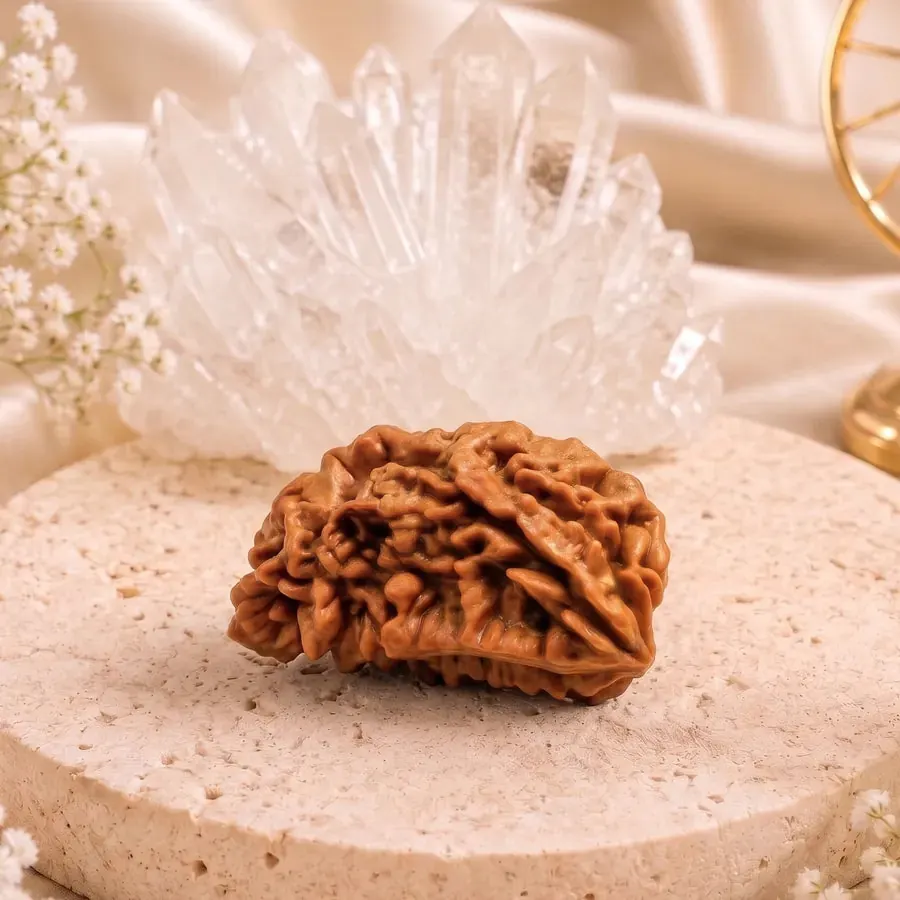
One face, one Shiva: where the 1 mukhi rudraksha benefits come from
Turn a rudraksha in your fingers and count the natural lines, called mukhi or faces, that run from one end of the seed to the other. Most malas are strung from five-faced beads. The ek mukhi rudraksha has a single line, and the 1 mukhi rudraksha benefits that tradition speaks of follow from it: stillness, focus and a steadier practice of meditation. In the Shaiva tradition that lone face is read as Lord Shiva himself, the one undivided consciousness behind everything, which is why devotees hold it as the most sacred bead of all.
The name points the same way. Rudraksha means "the eye (or tears) of Rudra", and the beads are the dried seeds of trees of the genus Elaeocarpus, mainly Elaeocarpus ganitrus. Every face count carries its own meaning in the texts and in living practice; the count of one is the one devotees give to Shiva in his undivided form.
Be just as clear about what the bead does not offer. It is not a remedy for illness, a route to a job or a shortcut to money, and no honest seller should say otherwise. People wear it as a reminder and a support for practice. Where something in your life needs a doctor, a lawyer or a financial adviser, the bead stands in for none of them.
The Sun: a later astrological layer
Many modern guides add a planet: the Sun (Surya), the graha of the self, authority and clarity. Classical texts tie each mukhi more firmly to a deity than to a planet, so treat the Sun link as something astrologers built on top of the tradition, not settled doctrine.
It still shapes how astrologers recommend the bead. When a chart's Sun is weak by sign or afflicted, some astrologers read that as a reason to consider a 1 Mukhi. That is a judgement about one chart, never a rule for everyone.
To see whether the Sun link applies to you at all, make your free kundli. It shows the Sun's sign, house and strength in your own chart. You can also put the question to Astroliya's AI astrologer: it reads your calculated chart, shows its reasoning and will say so when a bead isn't the point.
A bead for an established practice, not a first bead
Placed beside its neighbours, the 1 Mukhi stands at the top of the ladder.
| Mukhi | Deity most often named | Theme people associate with it |
|---|---|---|
| 1 Mukhi | Shiva | Stillness, oneness, meditation |
| 4 Mukhi | Brahma | Learning, speech, study |
| 5 Mukhi | Kalagni Rudra (a form of Shiva) | Everyday prayer, calm, japa |
| 7 Mukhi | Mahalakshmi | Steadiness around money and effort |
Families who wear rudraksha, and most guides, begin lower down, with the 5 Mukhi: common, affordable and suited to almost anyone. Astrologers traditionally keep the 1 Mukhi for people whose lives are already turning towards sadhana (spiritual practice), and its themes are concentration, detachment and a quieter mind. It is a bead people arrive at deliberately, not one they try out.
Those tradition most often pictures wearing it:
- People with a regular meditation, japa or puja practice who want one bead to anchor it.
- Devotees of Shiva, especially those who keep Mondays or observe Maha Shivratri.
- People whose charts astrologers read as calling for a stronger Sun, as described above.
- People in roles that ask for clear judgement and composure, who want a personal reminder to stay centred.
Those usually pointed elsewhere first:
- Anyone unsure whether rudraksha is for them. The 5 Mukhi is the traditional starting point.
- Anyone with a particular goal such as study, marriage or work, where tradition matches other mukhis to the goal. Our decision guide to choosing a rudraksha works through that by goal, rashi and chart.
- Anyone being hurried, or told the bead is "essential" for them. No bead is essential.
Round or half-moon: two shapes sold under one name
Shop for a 1 Mukhi and you will meet two beads that look nothing alike.
| Form | What it looks like | What sellers usually say about it |
|---|---|---|
| Round 1 Mukhi | A round or near-round seed with a single line from top to bottom | Described in tradition as extremely scarce; the form most often faked |
| Half-moon (chandrakar or kaju) 1 Mukhi | Flattened, curved like a crescent or a cashew nut, with one line | Far more commonly sold; widely associated with southern India |
The round form has long been described as one of the hardest beads to find. We cannot put a number on how scarce it is, and you should doubt anyone who claims they can. The practical consequence of that reputation is simple: the round form draws the most forgeries, so it calls for the most careful buying.
A half-moon bead is not a fake 1 Mukhi. It is a different, more available shape with a following of its own. If a listing does not say which of the two you are buying, ask before anything else.
Four forgeries to know before you buy a 1 mukhi rudraksha original
A 1 mukhi rudraksha original is worth its price only if it is what it claims to be. These are the imitations buyers most often describe:
- Carved beads: a bead with more faces has its extra lines filled or smoothed, leaving one visible line.
- Engraved or moulded imitations: wood, resin or another seed shaped and marked to pass for a rudraksha, sometimes with an Om, trishul or Shivling carved on the surface.
- Joined beads: two pieces glued so that the seam reads as a natural line.
- Mislabelled half-moons: a half-moon bead passed off as a round one in a blurry photo.
Six questions to settle before you pay
- Which form is it? Round or half-moon, and which origin does the seller claim? A clear answer is a good sign; vagueness is not.
- What does the certificate actually say? Look for the testing lab's name and the test method, such as X-ray imaging, which labs commonly use to see the seed's internal chambers. A natural 1 Mukhi should show one face line outside and one matching chamber inside.
- Is the certificate tied to this bead? A photo of the bead on the certificate, a serial number, or both. A generic certificate that could belong to any bead proves little.
- Can you see the line clearly? Ask for sharp photos from several angles. The single line should run naturally from end to end, with no smoothed patches.
- What happens if a test disagrees? Read the return policy before paying: can you return the bead if an independent test contradicts the seller's certificate, and within what time?
- Is anyone rushing you? Countdown timers, "only one left" for a bead sold as scarce, or promises of results are reasons to stop, not to hurry.
The full set of checks, along with the popular home tests that prove nothing (the water float test, the coin-spin test), is in how to identify original rudraksha.
What the certificate can and cannot tell you
A good lab certificate can show that a bead is a natural rudraksha seed, that it has the number of faces claimed, and that it has not been visibly joined or carved. For a round 1 Mukhi that is close to essential.
It cannot show:
- That the bead will bring any particular result. No lab tests for spiritual effect.
- The bead's exact origin, unless the lab says it examined that and how.
- That the certificate belongs to your bead, unless it carries a photo or serial you can match.
- That the lab is independent of the seller, unless you check.
That holds for every seller, Astroliya included. Our guide to what a certified rudraksha certificate proves reads one line by line, and the comparison of Nepali and Indonesian rudraksha explains what origin does and does not change.
Astroliya's round Nepali pendant, in its listing's own words
Astroliya's store carries one 1 Mukhi: a round Nepali 1 Mukhi pendant. Its listing describes it this way:
- It is a round bead, of Nepali origin, sold as a pendant.
- It has "a naturally formed single-face structure with its own unique shape, texture and surface characteristics."
- "Each natural bead can vary in size, shape, texture and appearance."
- It "is carefully selected and comes with certification for authenticity, providing an additional reference when choosing a genuine piece."
Measured against the questions above, the listing answers the first (round, Nepali) and confirms a certificate. It does not name a laboratory or a test method, and we will not add one here. For a bead at this level those details reasonably matter, so ask the store for them before you buy. The pendant sits beside the others in the rudraksha pendants collection.
Why a 1 Mukhi sits at the top of the price range
Prices change, so none are quoted here; the product page always shows the current one. The reasons this bead costs more than other mukhis are steadier:
- Its scarcity reputation: the round form above all is described as very hard to find.
- The cost of proving it: a bead worth faking is a bead worth testing, and proper imaging and certification add to the price.
- The setting: a pendant includes its mounting, not only the bead.
A higher price does not buy a stronger effect, and it does not make the bead an asset that will gain value. Choose a 1 Mukhi because it fits your practice, never as an investment.
Mondays, Om Hreem Namah and a secure setting
Customs differ between families and teachers. These are the commonly followed ones, not requirements.
- Day: as with other Shiva beads, many people first wear it on a Monday, after a morning bath.
- Mantra: the mantra most often given for the 1 Mukhi is "Om Hreem Namah". Many people simply use "Om Namah Shivaya". If you chant on a mala, our guide to mantra japa rules covers counting and posture.
- How it is worn: usually as a pendant on a silk or cotton thread, or set in silver or gold, resting near the heart.
- Care: keep it dry and away from soap, perfume and chemicals, and wipe it gently after wearing. Some people oil it lightly now and then; if you do, use very little and let it dry fully.
- When it comes off: many people remove it while sleeping, bathing or at a funeral, and keep it in a clean cloth or box.
With a round 1 Mukhi, the most useful habit is a practical one: a secure setting and a sturdy thread matter more than any ritual detail. Check the knot or clasp every few weeks.
Ek mukhi questions, answered briefly
What are the main 1 mukhi rudraksha benefits?
Tradition gives the 1 Mukhi to Shiva and describes its benefits as inner ones: focus, calm, detachment and support for meditation. Many astrologers also connect it with the Sun. It is not a treatment for any illness or a promise of worldly success.
Can anyone wear an ek mukhi rudraksha?
Tradition does not forbid it, but most guides suggest starting with a 5 Mukhi and choosing a 1 Mukhi later, deliberately. For a chart-based view, look at your Sun in your free kundli or ask the AI astrologer what your chart suggests.
Is a round 1 Mukhi better than a half-moon one?
They are different forms, not better and worse versions. The round one is the form tradition calls scarcest and the one most often faked, so it needs the most careful buying. Either way, the seller should tell you plainly which form it is.
How do I know a 1 mukhi rudraksha is original?
Ask for a certificate that names the lab and test method and is tied to your bead by photo or serial, study clear photos of the single line, and read the return policy before paying. Float and coin tests at home prove nothing.
Does Astroliya's 1 Mukhi come with a certificate?
Yes. The listing says the round Nepali pendant "comes with certification for authenticity". It does not name the lab or the test used, so ask the store if you want those details before buying.
From the Astroliya store
Pieces for this guide
Chosen from our own store to go with what you just read.


