

Gauri Shankar Rudraksha for Marriage: What the Tradition Says and How to Choose One
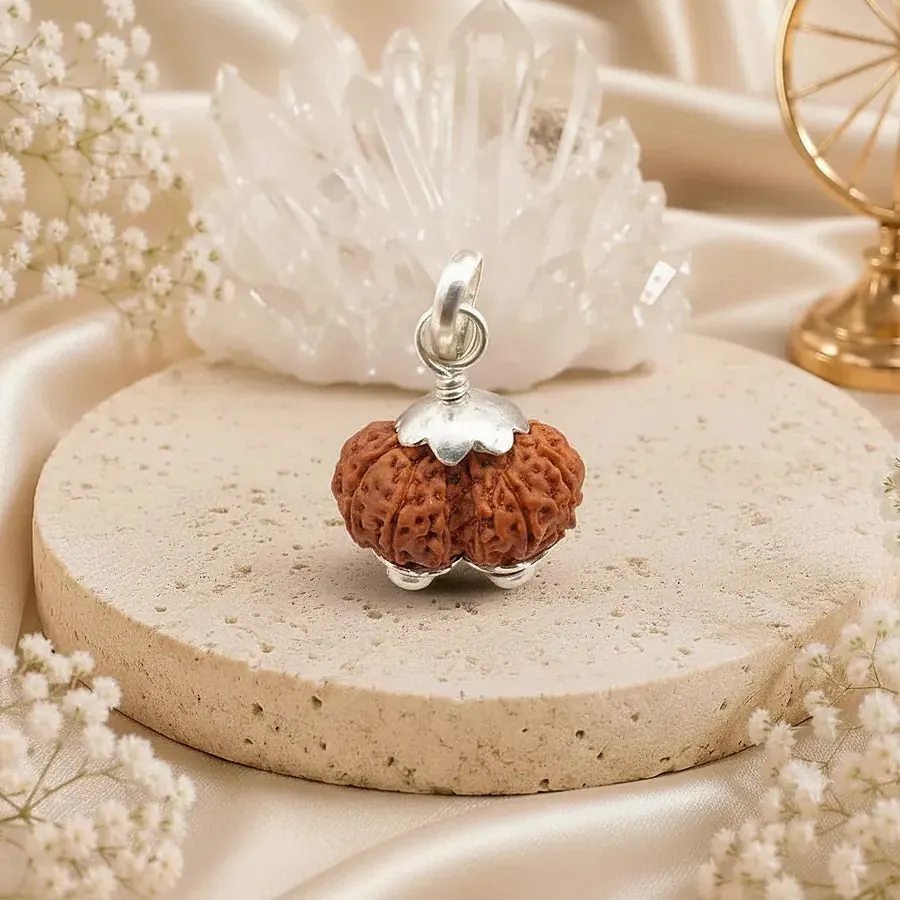
Gauri is a name of Parvati and Shankar a name of Shiva, and the bead that carries both names is two rudraksha seeds that fused while still on the tree. Couples keep one as a reminder of that partnership; it is a devotional object, not a fix for a marriage.
Quick answer
People searching for Gauri Shankar rudraksha benefits for marriage usually want to know one thing: will keeping this bead help a marriage? The honest answer from the tradition is narrower than most product pages suggest. A Gauri Shankar is two rudraksha beads that grew joined on the tree, and Shaiva tradition reads that join as Shiva and Parvati, the divine couple. Devotees keep it as a reminder of unity, patience and mutual respect in a marriage or a family, and use it in prayer and meditation.
What it does not do is decide anything. No bead makes two people compatible, fixes a disagreement it is never told about, or brings a proposal on a date. Treat it as a devotional object that keeps a couple's shared intention in view, and take the practical questions (compatibility, timing, family worries) to conversation, to both families and, if you want the astrological view, to a reading of both charts.
- What it is: a naturally fused pair of rudraksha beads.
- What it stands for: Shiva and Parvati, Shiva and Shakti, two who stay distinct yet joined.
- What people traditionally keep it for: harmony, understanding and steadiness in marriage and family life.
- What it is not: a remedy that changes a horoscope, a substitute for counselling, or a promise of any marriage outcome.
What a Gauri Shankar rudraksha is
A rudraksha is the dried seed of the Elaeocarpus tree, traditionally classed by the number of natural lines, or mukhis, running from top to bottom. Most beads grow singly. Occasionally two seeds grow fused along one side, so the pair sits like two beads pressed shoulder to shoulder, each with its own mukhi lines and a shared bridge of seed between them. That fused pair is what sellers and devotees call a Gauri Shankar rudraksha.
The name carries the meaning. Gauri is a name of Parvati, Shankar a name of Shiva. In Shaiva and Shakta tradition the two are the model of a partnership in which neither disappears into the other: Shiva as stillness and awareness, Parvati as energy and action, complete only together. A bead that is visibly two, yet one, became the natural symbol of that pairing.
Because the join is natural, no two pieces look alike. The two halves can differ in size, in the number of mukhis on each side and in how wide the bridge between them is. That variation is normal, and it is one of the things you look at when judging whether a pair grew joined or was put together later (more on that below).
Gauri Shankar rudraksha benefits for marriage: what tradition says, and what it doesn't
When rudraksha guides list the benefits of a Gauri Shankar, they are describing what devotees traditionally associate with the bead, not measured effects. Read in that spirit, the associations fall into three groups.
- Harmony between partners. The bead is kept as a reminder of the Shiva-Parvati ideal: two people who respect each other's nature and act as one household. Some couples keep it on the home altar and offer a short prayer together.
- Family bonding. Because the symbol is about joining, families also keep it for steadiness at home more broadly: between parents and children, or across a joint family.
- Spiritual practice. Many people simply use it in meditation or wear it as a pendant, with no marriage question at all.
Those asking before marriage often hope it will ease delays or smooth out a difficult match. Here it helps to be plain about what the tradition does not claim:
| Common hope | What a Gauri Shankar can honestly be | What it is not |
|---|---|---|
| A delayed marriage will happen soon | A daily reminder of what you are hoping for, held with prayer | A way to change marriage timing |
| A low guna score will stop mattering | A shared devotional practice for the couple | A cancellation of any koota or dosha |
| Arguments at home will stop | A cue to pause, pray together and talk | A replacement for conversation or counselling |
| Manglik worry will go away | Comfort while you get the chart read properly | A remedy that removes Mangal dosha |
Gauri Shankar vs Garbh Gauri vs 2 Mukhi: how they differ
Three rudraksha forms get mentioned together because all three are linked to Shiva and Parvati. They are not the same thing, and they are traditionally kept for different reasons.
| Form | What it looks like | What tradition usually links it to |
|---|---|---|
| Gauri Shankar | Two beads of similar size naturally joined side by side | Shiva and Parvati as a couple; harmony in marriage and family |
| Garbh Gauri | One larger bead naturally joined to a much smaller one | Parvati with the child (often read as Ganesha); traditionally associated with wishes around childbirth and motherhood |
| 2 Mukhi | A single bead with two natural lines | Ardhanarishvara, the half-Shiva, half-Parvati form; traditionally linked with the Moon and with unity |
If your question is about a marriage itself, the Gauri Shankar is the form tradition points to. If it is about having a child, people traditionally speak of the Garbh Gauri instead, and that is a question for a doctor first. Astroliya's store does not list a Garbh Gauri or a 2 Mukhi bead at the time of writing, so we describe them here only so you know what you are looking at elsewhere.
Natural join or glued pair: what to look at
Because a fused pair is uncommon and valued above a single bead, it is a form people imitate by gluing two ordinary beads together. A few checks help, though none is final on its own.
- Look at the bridge. On a natural pair the surface texture runs continuously across the join, with no sharp line or groove. A glued pair often shows a seam, a fill of resin or a shine that differs from the rest of the bead.
- Look at the mukhi lines. Natural lines run cleanly from top to bottom of each half. Lines that stop abruptly at the join, or that look cut, are a warning.
- Look at the holes. Natural beads have their own seed channels; a pair that has been drilled straight through both halves in one line can be a sign of assembly, though some genuine pieces are drilled too.
- Ask for an internal check. A lab X-ray shows the seed compartments inside each half and whether the halves are fused or merely stuck. This is the one test that looks inside.
Popular home tests such as floating the bead in water, rubbing it between two coins or watching it turn between copper plates do not tell a natural pair from a fake. Our guide on how to identify original rudraksha goes through which checks work and which don't, and what a lab certificate proves explains what such a document can and cannot tell you.
How to choose one: the two listings on Astroliya's store
The Astroliya store currently has two Gauri Shankar listings. We describe each by what its own page states, without ranking them; you decide what matters to you.
- Natural Gauri Shankar Rudraksha Bead - Lab Certified describes a naturally joined pair, traditionally regarded as the union of Shiva and Parvati, valued for relationships, family harmony, mutual understanding and spiritual practice. Its description states: "This bead is lab certified, giving you an additional reference for its authenticity and identification."
- Gauri Shankar Rudraksha Bead - Authentic Sacred Seed describes two rudraksha beads grown joined, traditionally valued for relationship harmony, family bonding, marriage and spiritual practice, and names the naturally joined formation as its key feature. Its description does not mention a lab certificate.
Both note that every natural piece differs in shape, texture and size, so the bead you receive will not look exactly like any photograph. Before buying either, decide what you need: if an independent reference for identification matters to you, only one of the two listings says it is lab certified. Ask the store anything the page does not answer, and read the certificate itself when it arrives rather than relying on the word alone. You can compare them with the other loose beads in the rudraksha beads collection.
Wearing it vs keeping it on the altar
There is no single rule, and practice varies from family to family. These are the common traditional choices.
| Option | How it is usually done | Suits someone who |
|---|---|---|
| On the home altar | Placed on a clean cloth near the family's images of Shiva and Parvati, included in daily or Monday prayer | Wants it as a shared object for the couple or household |
| As a pendant | Strung on silk or wool thread, or capped in silver, worn so it rests near the heart | Wants a personal, daily reminder |
| In meditation | Held in the hand during prayer or japa, then put back on the altar | Mainly uses it for spiritual practice |
Many people start on a Monday, Shiva's day, after a bath, and recite a simple mantra such as "Om Gauri Shankaraya Namah" a set number of times. Some families also follow customs such as removing the bead before sleep or at a funeral; follow what your family or temple priest advises. If you count mantras, our guide to mantra japa rules covers the basics of counting on a mala.
Care is simple: keep it dry, wipe it with a soft cloth, avoid soap, perfume and chemicals, and now and then rub in a drop of plain oil if it looks dry. A crack or a loosening of the join is worth having checked rather than ignoring.
When the question is compatibility, read both charts
Very often the real question behind a Gauri Shankar search is "are we a good match?" or "why is my marriage getting delayed?". Those are chart questions, and a bead cannot answer them.
In the Vedic tradition, compatibility is traditionally checked first by Kundli Milan: eight kootas worth 36 points, read from both partners' Moon signs and nakshatras, alongside checks such as Mangal dosha. Our explainer on how Guna Milan counts 36 points walks through every koota, and you can run your own pair on the free Kundli matching tool, which shows each koota's score and why. A score is only the start: astrologers traditionally also read the 7th house, Venus and the running dasha in each chart, and love marriage yoga explains the house links they look for.
If you want the reasoning explained in plain language, you can ask Astroliya's AI astrologer. It is an AI, not a person: it reads the chart calculated from your birth details and explains its reasoning rather than handing you a verdict.
Questions people ask
What are the main Gauri Shankar rudraksha benefits?
In the tradition, a Gauri Shankar is kept as a symbol of Shiva and Parvati, for harmony, understanding and steadiness in a marriage or family, and for meditation. These are devotional associations, not proven effects, and they describe a mindset the bead reminds you of rather than an outcome it delivers.
Can a Gauri Shankar rudraksha cancel a low guna score or Manglik dosha?
No classical rule treats a Gauri Shankar as cancelling a koota or Mangal dosha. Where the tradition does set a koota aside, the reason comes from the charts themselves: for example, Bhakoot dosha is traditionally relaxed when both Moon signs share the same ruling planet. Run both charts through matching and read the details before drawing any conclusion.
Who should not wear a Gauri Shankar rudraksha?
The tradition sets few restrictions, and anyone may keep one on the altar. Families differ on customs around sleep, funerals and personal routines, so follow your family's or priest's advice. If you have a skin sensitivity, a silver cap or keeping it on the altar avoids contact.
Is a Gauri Shankar the same as a Garbh Gauri?
No. A Gauri Shankar is two beads of similar size joined together, linked with the couple. A Garbh Gauri is a large bead joined to a much smaller one, traditionally linked with mother and child. Astroliya's store lists the Gauri Shankar but not the Garbh Gauri.
Should we buy the bead before or after kundli matching?
The bead and the chart answer different questions, so the order is yours. If compatibility is the worry, match first: it gives you something concrete to discuss with both families. The bead can then be a shared devotional reminder, whatever the chart says.
From the Astroliya store
Pieces for this guide
Chosen from our own store to go with what you just read.


