

Eclipses 2027: Surya Grahan and Chandra Grahan Dates, and What India Will See
The Surya Grahan 2027 most people in India will notice is the total solar eclipse of 2 August, and from most of the country it will look partial. The year's three lunar eclipses are all penumbral, faint enough to miss, and usually carry no sutak.
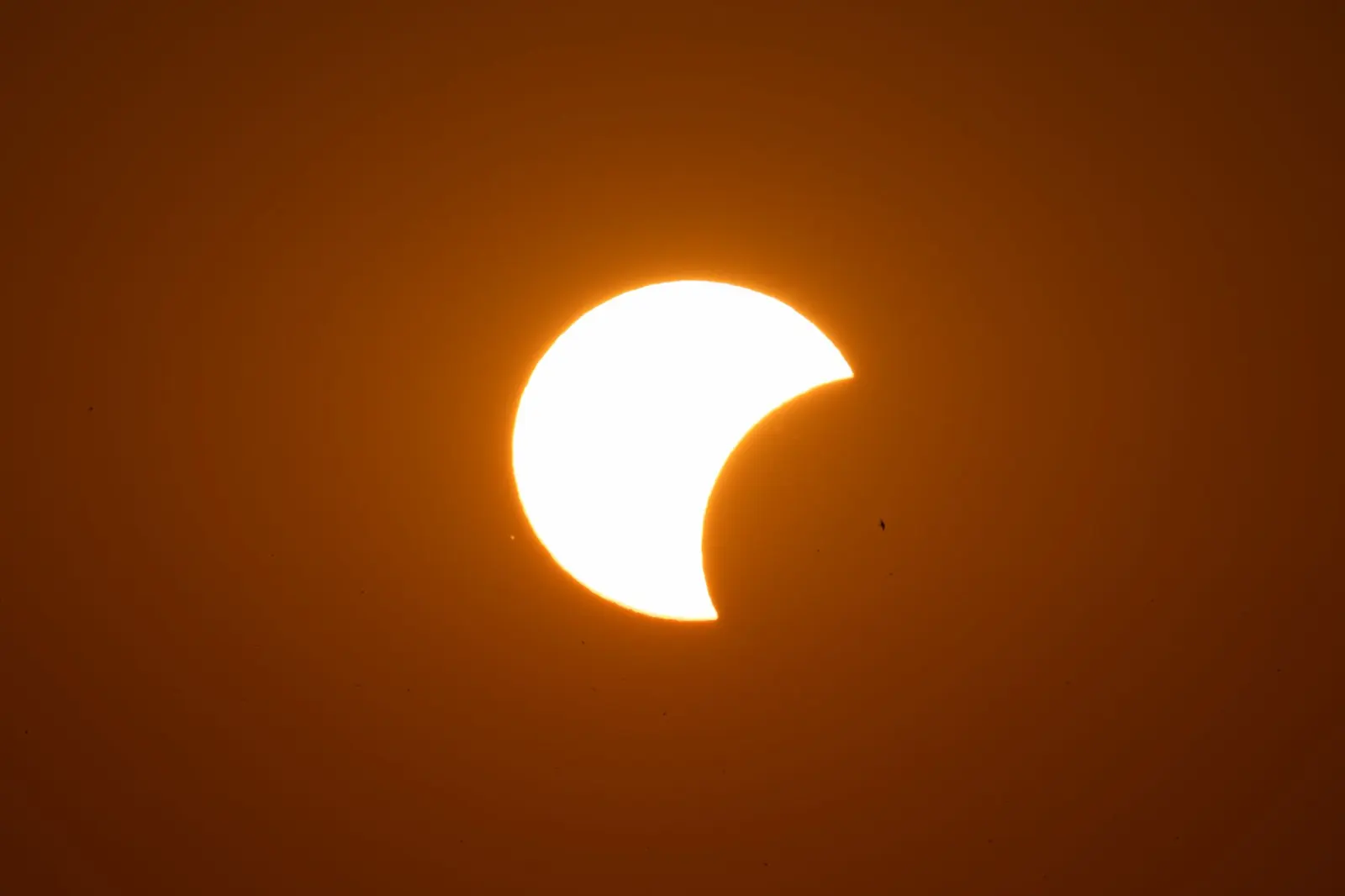
Surya Grahan 2027 comes twice: an annular solar eclipse on 6 February and a total solar eclipse on 2 August, which most of India will see only as a partial one. Between and around them sit three penumbral lunar eclipses, the faintest kind there is (one of them listed by only one of our two sources). In a penumbral eclipse the Moon never enters Earth's dark inner shadow, so from a terrace you may see one side of the full Moon look slightly dull, or nothing unusual at all.
What this page does not do is print city timings. Start, maximum and end times, how much of the Sun is covered, and when sutak begins all change from city to city, and we have not verified them. For those, check your own city on Drik Panchang (it opens on New Delhi timings; change the city to yours) or your family's panchang.
Surya Grahan 2027 and Chandra Grahan 2027 at a glance
| Date | Day | Eclipse | Type | Sidereal sign | Listed by |
|---|---|---|---|---|---|
| 6 Feb 2027 | Saturday | Surya Grahan | Annular (valayakara) | Capricorn (Makara) | PanchangBodh; Drik Panchang |
| 21 Feb 2027 | Sunday | Chandra Grahan | Penumbral (upachchaya) | not in our sources | PanchangBodh; Drik Panchang |
| 18 Jul 2027 | Sunday, Guru Purnima | Chandra Grahan | Penumbral | not in our sources | PanchangBodh only |
| 2 Aug 2027 | Monday | Surya Grahan | Total (purna), partial from most of India | Cancer (Karka) | PanchangBodh; Drik Panchang |
| 17 Aug 2027 | Tuesday, Raksha Bandhan | Chandra Grahan | Penumbral (upachchaya) | not in our sources | PanchangBodh; Drik Panchang |
Notice how the dates cluster: 6 and 21 February, then 18 July, 2 August and 17 August, each a fortnight apart. That is not coincidence. An eclipse can only happen when a new or full Moon falls close to the two points where the Moon's path crosses the Sun's, and the Sun passes those points roughly every six months. Vedic astrology names those two points Rahu and Ketu, which is why the Puranic story of the grahan centres on them.
What you will actually see: annular, total, partial and penumbral
The words on a calendar describe the eclipse at its best place on Earth, not necessarily at yours. Here is what each one looks like from the ground.
| Type | What happens | What you see | Safe to look at directly? |
|---|---|---|---|
| Total solar | The Moon covers the whole Sun | Daytime darkness for a few minutes, but only inside a narrow path | No, except during totality itself, which India will not get in 2027 |
| Annular solar | The Moon is too far away to cover the Sun fully | A ring of sunlight, only inside a narrow path | No |
| Partial solar | The Moon covers part of the Sun | A Sun with a "bite" taken out of it; daylight may barely change | No |
| Penumbral lunar | The Moon passes through Earth's faint outer shadow | At most a slight greyish shading on one edge; many people notice nothing | Yes |
So a "total" eclipse is total only along its path. Outside it, over a much wider area, the same eclipse is partial. That is exactly the case on 2 August 2027.
Solar eclipse 2 August 2027: what India will see
The 2 August eclipse is a total solar eclipse, but the path of totality lies outside India. From most of India it will be seen as a partial eclipse: the Moon will cover part of the Sun for a while and then move off. How much of the Sun is covered, and for how long, depends on where you are, and we have not verified those figures city by city, so we do not give them. Some places may see very little; check yours.
A few things make this date stand out in the calendar:
- It falls in Sawan. In the Purnimanta calendar followed across much of north India, Sawan 2027 runs from 19 July to 17 August, so 2 August is a Sawan Somvar. Our Sawan 2027 guide lists every Monday and how families plan the vrat around the eclipse day.
- It is an Amavasya. Every solar eclipse happens at a new Moon, so the day is also the month's Amavasya.
- The Sun and Moon are in Cancer, the sign Ketu occupies from 5 December 2026. Our article on the Rahu-Ketu transit from December 2026 explains that period.
For anyone outdoors that day: a partial solar eclipse is the kind people are most tempted to glance at, because the sky looks normal. The eye-safety section below applies in full.
6 February 2027: the annular Surya Grahan
The year's first eclipse is annular, called valayakara (ring-shaped) in Hindi calendars, and it falls in Capricorn, the sign Rahu occupies from December 2026. The "ring of fire" is seen only along a narrow track. Our sources do not say whether any part of India sees this eclipse at all, even as a partial one, so we will not guess. If your panchang marks it as not visible for your city, the traditional view below means no sutak applies to you.
The penumbral Chandra Grahan dates: 21 February, 18 July and 17 August
All three lunar eclipses of 2027 are penumbral, called upachchaya in Hindi calendars. In a penumbral eclipse the Moon never enters Earth's dark inner shadow, so there is no visible "bite" as in a partial or total lunar eclipse. On a clear night you may see one side of the full Moon look slightly dull, or you may see nothing unusual at all.
- 21 February (Sunday): listed by both PanchangBodh and Drik Panchang.
- 18 July (Sunday, Guru Purnima): listed by PanchangBodh only. If you are planning Guru Purnima puja, go by your own panchang.
- 17 August (Tuesday, Raksha Bandhan): listed by both PanchangBodh and Drik Panchang.
Many panchang makers do not treat a penumbral lunar eclipse as a grahan for religious purposes, so no sutak is kept and the festival day goes ahead as usual. Families differ, so if yours keeps a different custom, follow your family priest or panchang.
Eclipse 2027 sutak: when tradition applies it
Sutak is the period before an eclipse that many families treat as unsuitable for cooking, eating, starting new work or temple worship. The traditional view has three parts, and the first is the one most often forgotten.
- Sutak is kept only for an eclipse visible where you are. If the grahan cannot be seen from your city, tradition does not apply sutak there, whatever the news headlines say.
- Its start is counted back from the eclipse's local start. Panchangs commonly reckon it from about twelve hours before a solar eclipse and nine hours before a lunar one. Because the eclipse starts at a different moment in each city, the sutak start differs too; we do not print it. Take it from your panchang for your city.
- It ends when the eclipse ends. Families traditionally bathe, clean the house and then eat freshly cooked food.
What families commonly do during an eclipse: put tulsi leaves or kusha grass in stored food and water, sit for mantra japa (which tradition holds is especially fruitful during a grahan), and give in charity afterwards. Many temples close their doors for the period.
What sutak does not mean is just as important. Tradition itself relaxes sutak for children, the elderly and the unwell. There is no medical reason to skip meals or medicines because of an eclipse, and anyone pregnant, diabetic or on regular medicine should follow their doctor, not a fast. An eclipse is not a reason to cancel a hospital appointment, a flight or an exam.
Watching safely, without fear
Being outdoors during an eclipse is not harmful. The only real risk is looking straight at the Sun, and that risk is the same on any day; an eclipse simply tempts people to do it.
- Lunar eclipses are safe to watch with your eyes. Binoculars help you see the faint shading of a penumbral eclipse.
- Never look at a partial solar eclipse directly. Sunglasses, smoked glass, old X-ray film and reflections in water do not protect your eyes.
- Use proper solar viewers marked as meeting the ISO 12312-2 standard, or watch indirectly with a pinhole: a small hole in a card throws an image of the Sun onto paper, and the holes in a steel colander do the same.
- Cameras, phones on zoom, binoculars and telescopes need a proper solar filter fitted on the front. Looking through them at the Sun without one can damage your eyes quickly.
- Keep an eye on children, who may glance up without thinking.
Each eclipse by Moon sign: the house it falls in
Astrologers traditionally read an eclipse by counting from your Moon sign (rashi) to the sign the eclipse falls in. The table below is that count for the two solar eclipses whose signs our sources give. It is arithmetic, not a prediction. If you do not know your Moon sign, your free kundli shows it.
| Your Moon sign | 6 Feb eclipse (Capricorn) | 2 Aug eclipse (Cancer) |
|---|---|---|
| Aries (Mesha) | 10th | 4th |
| Taurus (Vrishabha) | 9th | 3rd |
| Gemini (Mithuna) | 8th | 2nd |
| Cancer (Karka) | 7th | 1st |
| Leo (Simha) | 6th | 12th |
| Virgo (Kanya) | 5th | 11th |
| Libra (Tula) | 4th | 10th |
| Scorpio (Vrishchika) | 3rd | 9th |
| Sagittarius (Dhanu) | 2nd | 8th |
| Capricorn (Makara) | 1st | 7th |
| Aquarius (Kumbha) | 12th | 6th |
| Pisces (Meena) | 11th | 5th |
The two eclipses sit in opposite signs, so for every Moon sign they fall in opposite houses: home and career, for example, or self and partnership. In the Parashari tradition the house shows which area of life the eclipse highlights: 1st self and health, 2nd family and savings, 3rd effort and siblings, 4th home and mother, 5th children and learning, 6th work routine and disputes, 7th marriage and partners, 8th sudden change and research, 9th fortune and teachers, 10th career, 11th gains and friends, 12th expenses and rest.
A highlighted house is not a bad omen. Astrologers do not judge an eclipse from the Moon sign alone; they look at whether it falls close to a planet in your own birth chart and which dasha you are running. For the year's slower and weightier movements, such as Saturn entering Aries on 3 June, see our Shani Gochar 2027 guide and the Horoscope 2027 overview for all 12 rashis.
How to check an eclipse for your own city
- Open your panchang's eclipse page for 2027 and set your city. Drik Panchang defaults to New Delhi; change it.
- See whether the eclipse is marked visible from your city. If it is not, the traditional view is that no sutak applies there.
- If it is visible, note the start, maximum and end times, and the sutak start your panchang gives.
- On Astroliya, the festival calendar lists eclipses among its sky events for the coming months, with a note on whether each is visible from the place it is set for, and the panchang shows the day's tithi and nakshatra for your place.
- For a reading against your own chart, ask Astroliya's AI astrologer, which reads from your calculated kundli and labels itself as AI.
More dated guides for the year are in our festivals section.
Questions people ask
Will the 2 August 2027 solar eclipse be visible in India?
Yes, from most of India, but only as a partial eclipse: totality happens outside India. How much of the Sun is covered and at what time depends on your city, so check your city on Drik Panchang or your own panchang before the day.
Is sutak observed for a penumbral lunar eclipse?
Many panchang makers do not treat a penumbral (upachchaya) lunar eclipse as a grahan for religious purposes, so no sutak is kept. All three lunar eclipses of 2027 are penumbral. If your family follows a different custom, go by your family priest or panchang.
Is there a Chandra Grahan on Guru Purnima, 18 July 2027?
PanchangBodh lists a penumbral lunar eclipse that day; Drik Panchang's 2027 calendar does not. Even where it is listed, it is penumbral, so it would be faint and usually carries no sutak. Plan Guru Purnima by the panchang you follow.
Can I look at a partial solar eclipse with sunglasses?
No. Ordinary sunglasses, however dark, do not block enough light. Use solar viewers that meet the ISO 12312-2 standard, or watch the Sun's image through a pinhole projected onto paper.
Should I avoid starting anything new around an eclipse?
Many families avoid beginning new work, ceremonies or purchases during sutak and the eclipse itself, and muhurat makers usually leave eclipse days out. That is a traditional preference, not a rule about outcomes. Practical commitments such as work, travel, exams and medical care need not change.
From the Astroliya store
Pieces for this guide
Chosen from our own store to go with what you just read.


