

Vastu for Study Room: Desk Direction, Light and What to Avoid
In most Indian flats the study is not a room at all but a desk pushed against whichever wall was free, often the wrong one by the books. Vastu's study guidance survives that, because it is about the desk rather than the room. Six lines from Astroliya's study record, and what to do when east and north are both out of reach.
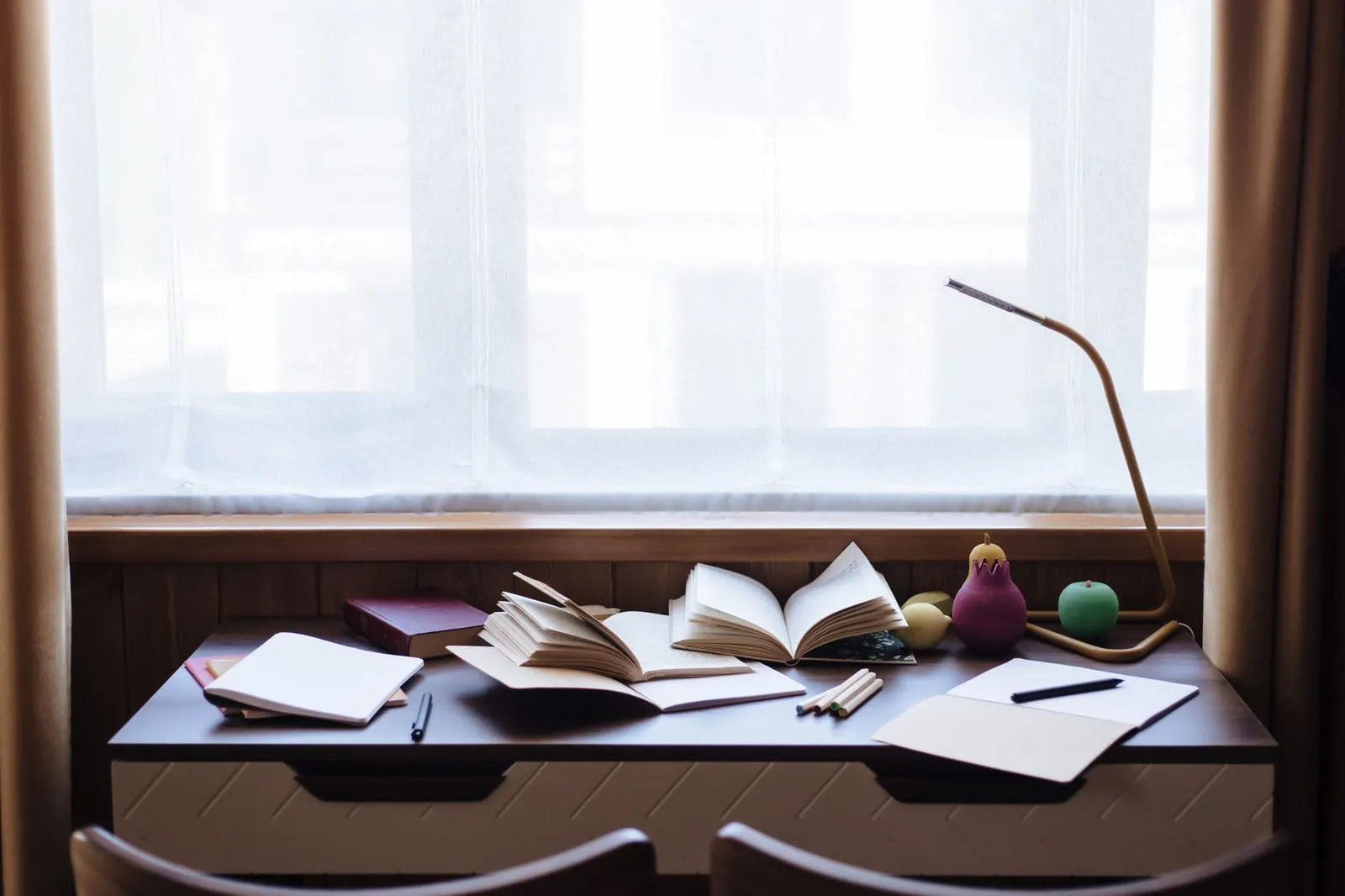
Ask where a child studies in a 2BHK and the answer is rarely "the study room". It is a desk wedged between the wardrobe and the window, or a fold-out table near the bed. The desk went where there was a free wall and a plug point, and nobody checked a compass. That is the real setting for vastu for study room advice, and it copes better than you might fear, because nearly every line of it concerns the desk, not the room. Vastu Shastra, the traditional Indian study of space and direction, cares about which way you face, what is at your back and what lies on the desk, and this guide follows the study record that Astroliya's free vastu tool shows when you pick Study.
Before the directions, the question parents ask most: will turning the desk help with marks? No desk direction does that. Vastu is a tradition about arranging a room so it feels settled and orderly; revision, sleep and practice papers still do the work. Take what follows as care for the space, not a substitute for study.
Vastu for study room in six lines
Here is the study record in Astroliya's vastu tool, unchanged. The same record exists in Hindi, as पढ़ाई का कमरा.
| What | Astroliya's study record |
|---|---|
| Traditional zone | North or east of the home |
| Lit directions on the compass | N and E |
| Keep | Face east or north while studying. Sit with a solid wall behind you. Keep only what you need on the desk. |
| Avoid | Sitting with your back to the door. A desk directly under an overhead beam. Piles of old papers on the desk. |
The rest of this guide is commentary on those six lines: why tradition holds each one, and how far you can bend it in a flat that was never planned around a desk.
Study table direction as per vastu: east or north
The first line of the record is the one most people are looking for: face east or north while studying. That means you sit so that your eyes look towards the east or the north wall, which usually puts the desk against that wall.
Why these two? Classical vastu texts assign each direction a presiding deity. The east is traditionally linked with Indra and with the Sun, which rises there, so facing east is read as facing the start of the day. The north is traditionally the direction of Kubera, and many vastu writers today also connect it with Budh (Mercury), the planet astrologers associate with learning, memory and speech. Astrologers traditionally read both as directions that suit work done with the mind.
So which of the two? The record treats them as equals. A simple way to choose:
| Your situation | What people usually pick |
|---|---|
| You study mostly in the morning | East, so the window light reaches the desk early |
| You study across long daytime hours | North, which gets softer, steadier daylight with less glare |
| Only one wall is free | Whichever of the two that wall allows |
| Neither east nor north is possible | See the next section; do not force it |
If you cannot face east or north
Some rooms only take a desk one way. Tradition generally treats west as workable, and south as the direction to avoid facing for long study hours if any other choice exists. If south is the only option, give more weight to the other five lines of the record: a wall behind you, a clear desk, the door in view. Those you can almost always get right, and they matter at least as much in daily use.
The three things to keep
The study direction as per vastu is only one line. The other two "keep" items are about how settled you are at the desk.
- A solid wall behind you. Vastu reads a wall at your back as support: nothing moving behind you, no one walking past your shoulder. In practice that means the desk does not float in the middle of the room with an open passage behind your chair. If the wall behind you has a window, a curtain gives some of the same feeling.
- Only what you need on the desk. One subject's books, the notebook in use, a pen, water, a lamp. The rest goes on a shelf. Traditional texts talk about clutter blocking the flow of energy in a space; the everyday version is that a clear desk leaves less to look at besides the page.
- Facing east or north, covered above.
The three things to avoid
- Sitting with your back to the door. Of all six lines, this one causes the most trouble in small flats, because the desk often goes wherever it fits. Tradition prefers that you can see the door from your seat. If you cannot turn the desk, a small mirror on the desk angled at the door is a common workaround, though in a bedroom keep it from facing the bed (our bedroom vastu guide explains why).
- A desk directly under an overhead beam. Vastu writers describe an exposed beam overhead as a weight on the person below. Move the desk out from under it, even by half a metre. If the room is small and the beam crosses it, a false ceiling is the structural fix, but nothing here asks you to build one.
- Piles of old papers on the desk. Last year's question papers, used notebooks and loose printouts collect quickly. Sort them once a week: keep what you are revising from, file the rest, recycle what is finished.
Light, screens and colour
The record does not cover light, but almost every household applies vastu for students together with it, so here is the practical side.
- Daylight. East and north windows are the reason those directions work well for a desk. Use them: keep the curtain open during the day and the window glass clean.
- The lamp. Place the desk lamp on the side opposite your writing hand (on the left if you write with your right hand), so your hand does not throw a shadow on the page. Use a lamp that lights the desk, not just the room.
- Screens. A laptop or monitor on the study desk is normal now. Keep it at the back of the desk rather than between you and your books, and close it when you switch to paper work.
- Colour. Light, calm wall colours are traditionally preferred for a study: off-white, cream, pale green or light yellow. A rented flat does not need repainting; a pin-board, a desk mat or a curtain can carry the colour instead.
A study corner in a shared bedroom
Most students in Indian homes do not have a study room at all. They have a desk in the corner of a bedroom they share with a sibling, or a fold-out table near the bed. The record still works, because every line is about the desk, not the room. One extra line comes from the bedroom record: tradition prefers that a desk or screen does not face the bed, so if you can, set the desk along a side wall rather than at the foot of the bed.
A worked example: one desk checked against the six lines
An invented case, to show the record in use rather than to read anyone's room. A Class 11 student shares the smaller bedroom, in the west of the flat, with her younger brother. His bed has its headboard on the east wall, the window is on the north wall and the door is in the west wall. Her desk stands against the south wall, under the edge of a loft, with her school bag, three subjects' books, an old calculator and last term's tests on it.
The east wall is taken, so she moves the desk under the north window. Then she goes down the record:
| Line of the record | Before | After the move |
|---|---|---|
| Face east or north | Faces south | Faces north, into window light |
| Solid wall behind you | Open floor; her brother crosses it to reach the cupboard | Only partly met: the room is too narrow, so a low bookshelf behind the chair closes the walkway |
| Back not to the door | Door behind her right shoulder | Door to her left, in the corner of her eye |
| Not under a beam | Loft beam over the desk | Nothing overhead |
| Only what you need | Bag, three subjects, calculator | Today's subject, a notebook, a pen, a lamp on her left as she writes right-handed |
| No piles of old papers | Last term's tests | Filed in a labelled folder on the new shelf |
Five lines met and one met halfway, which is a fair result for a shared room. The bedroom is still in the west of the flat; the record never asked her to change that, only the desk. The part no table covers is the one that probably matters most: a quiet hour agreed with her brother.
Vastu for students in exam season: habits first
Exam months are when families most often ask about study room vastu, and it is also when it matters least compared with routine. If you are setting up a desk before boards or entrance exams, here is the order we would suggest:
- Fix the routine. Same start time each day, short breaks, enough sleep.
- Fix the desk. The six lines above, which take an afternoon.
- Fix the light. A proper lamp and an open window during the day.
- Add tradition if it means something to you. A small image of Saraswati on the east or north wall, a lamp lit before study, or a mantra said before opening the books.
Some students also wear a bead linked with learning. Tradition most often names the 4 Mukhi rudraksha, associated with Brahma and with Mercury; our 4 Mukhi rudraksha guide explains who wears it and how, and is clear that no bead replaces revision. Many families also like to start a new subject or a child's first lessons on Vasant Panchami, Saraswati's festival, which falls on 11 February 2027; the Vasant Panchami guide explains the puja and the custom of starting to learn. All of this is optional.
How to set up your desk in ten minutes
- Stand near the middle of the room with your phone's compass app, away from steel almirahs and other large metal objects that can throw the reading off. Note which wall is east and which is north.
- Open Astroliya's vastu tool, pick Study and compare its lit directions with your room.
- Choose the wall you will face, using the table above.
- Check the door: can you see it from the chair? If not, turn the desk or add a small angled mirror.
- Look up: is the desk under a beam? Shift it.
- Clear the desk to today's subject.
For the rest of the home, the vastu shastra for home plan lays out every room's zone on one page.
What study room vastu does and doesn't mean
Vastu for a study room offers a tidy, calm way to arrange a desk, and much of it overlaps with plain good sense: daylight, a quiet back, a clear surface, the door in view. That overlap is real, and it is a fair reason to follow it.
It does not mean that a desk facing south causes poor results, or that turning a table will raise marks, improve memory or help anyone clear an exam. It is not a treatment for stress, poor concentration or attention difficulties; if a student is struggling for weeks, talk to their teacher, a counsellor or a doctor. And nothing here needs money spent: you can follow every line of the record with the furniture you already have.
If you want to talk through your own room layout, you can ask Astroliya's AI astrologer. For anything structural, such as moving a wall or a beam, ask an architect or engineer.
Questions people ask
Which direction should a student face while studying?
Vastu traditionally prefers east or north, and that is the first line of Astroliya's study record. East suits morning study and north suits long hours with steadier light. If neither is possible, west is usually treated as workable, and the other lines of the record (a wall behind, a clear desk, the door in view) matter just as much.
Can a study table be placed under a beam?
Tradition advises against a desk directly under an exposed overhead beam, and the record lists it under Avoid. The simple fix is to move the desk out from under the beam, even slightly. You do not need to rebuild the ceiling.
Is it bad to study in the bedroom as per vastu?
No. Most students study in a bedroom, and vastu guidance applies to the desk wherever it is. Face east or north if you can, keep a wall behind you and the door in view, and close screens at night so the bedroom stays a place to sleep.
Does study room vastu improve marks?
There is no basis for saying it does. Vastu offers a settled, uncluttered place to work, which many students find helpful, but marks come from study, sleep and practice. Treat it as one small part of a good routine, not as a shortcut.
Which colour is best for a study room?
Light, calm colours such as off-white, cream, pale green or light yellow are traditionally preferred. Very dark or loud walls are usually kept out of a study. Curtains, a pin-board or a desk mat can bring in the colour if you cannot paint.
From the Astroliya store
Pieces for this guide
Chosen from our own store to go with what you just read.
 45% off7 Horses Raw Pyrite Vastu Frame for Wealth, Success & Career Growth₹549
was ₹999Buy 10% offLakshmi Yantra Pyramid with Free Raw Pyrite Stone for Wealth & Prosperity₹899
was ₹999Buy 53% offASTROLIYA 7 Trunk Elephant Pyrite Wall Frame for Wealth & Prosperity₹699
was ₹1,499Buy Authentic 5 Mukhi Rudraksha Mala - 108 Beads for Meditation₹1,260.60Buy