

Vasant Panchami 2027: Date, Saraswati Puja and Starting to Learn
Saraswati Puja is a morning puja because of one calendar rule: the festival is kept on the day Panchami tithi holds the forenoon. For Vasant Panchami 2027 that day is Thursday 11 February in New Delhi, and your own city's sunrise sets the exact window.
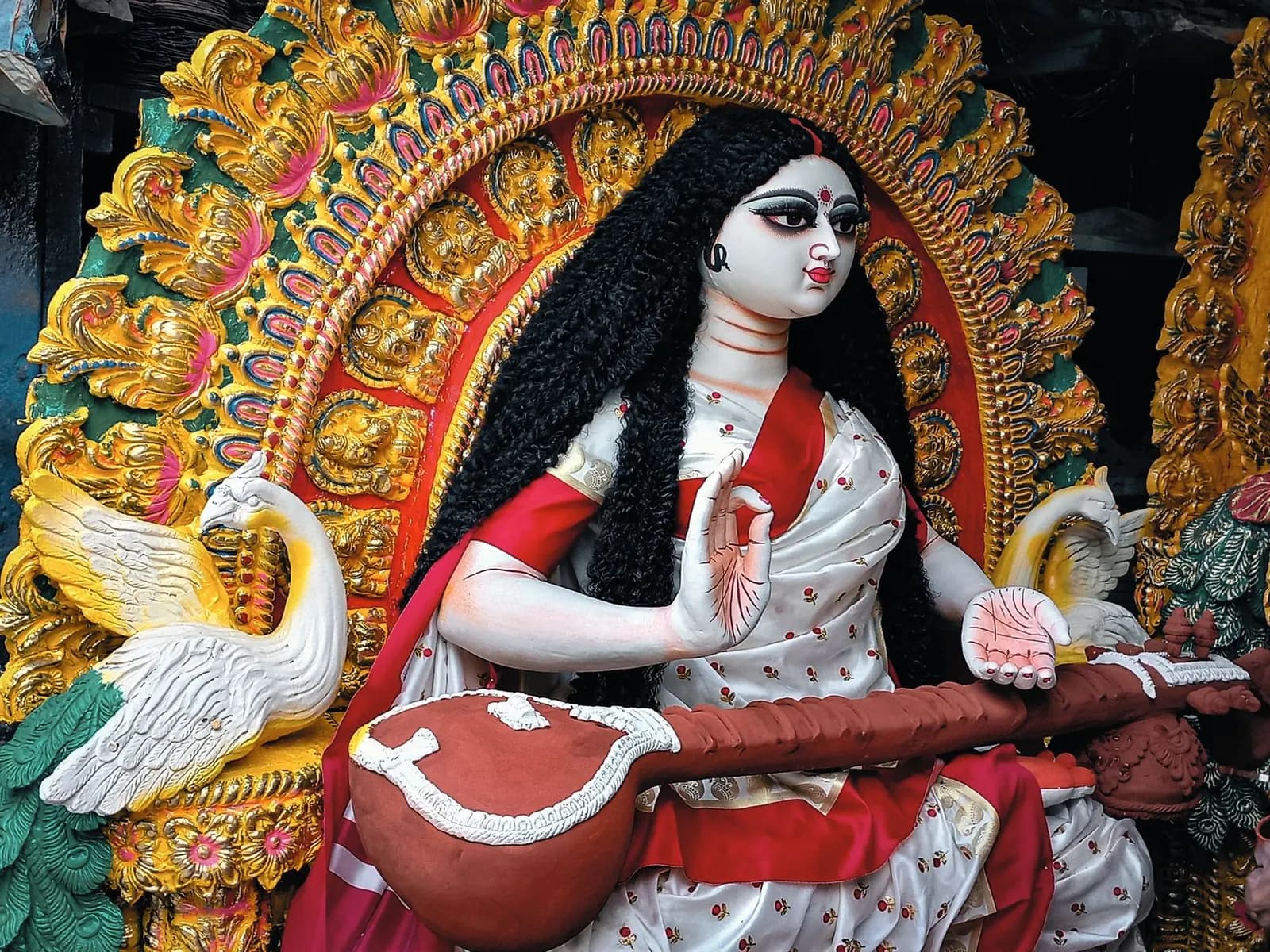
Vasant Panchami 2027 falls on Thursday, 11 February 2027 (New Delhi; check your city). It is the fifth day of the bright fortnight of Magha, the day many Indian families set aside for Saraswati, the goddess of learning, music and speech. Children place their books at her feet, homes fill with yellow, and in many families a small child writes his or her first letters. What the day cannot do is promise anyone better marks; what it does give a student is a set morning, kept with the family, to make a calm start on something new.
Vasant Panchami 2027 date at a glance
| What | 2027 |
|---|---|
| Vasant Panchami (Basant Panchami) | Thursday, 11 February 2027 |
| Saraswati Puja | Same day, in the morning (forenoon) |
| Tithi | Magha Shukla Panchami, the fifth day of the waxing Moon in Magha |
| Hindi name | वसंत पंचमी |
The date is the one given for New Delhi in the 2027 Hindu calendar published by Drik Panchang. A tithi begins and ends at a fixed moment for the whole world, but sunrise does not, so the part of the day it covers changes with your city. For the exact Panchami window and the morning hours where you live, open the panchang tool and choose your place; the festivals page lists the other festivals of the year.
We have not printed a puja muhurat with clock times here, because we could not confirm a published 2027 figure while writing. The rule below lets you read the window for yourself from any panchang.
Why Saraswati Puja is a morning puja: Panchami in the purvahna
A tithi is a lunar day. It can start at any hour and runs roughly a day, so on most festivals the calendar maker has to decide which civil date "holds" it. For Vasant Panchami, the traditional rule looks at the purvahna, the forenoon: the first half of the daytime, from sunrise to the middle of the day.
The festival is kept on the date when Panchami is current during the purvahna, and Saraswati Puja is done within that forenoon while Panchami lasts. That is why the puja is a morning event, why schools hold it before lunch, and why families who keep it carefully finish the main worship well before midday.
A worked illustration of the rule
This is an illustration, not the 2027 timing. Suppose, in some city, Panchami begins at 2:00 PM on a Wednesday and ends at 4:00 PM on Thursday, with sunrise near 7:00 AM and midday near 12:30 PM.
- On Wednesday, Panchami starts after midday, so it never touches Wednesday's forenoon.
- On Thursday, Panchami runs from sunrise right through the forenoon.
- So Thursday is Vasant Panchami, and the puja is done on Thursday morning, between sunrise and about 12:30 PM.
When the tithi touches the forenoon on two days, or on neither, panchang makers apply further rules, which is why two printed calendars can now and then differ by a day. If yours does, follow the one your family or temple uses.
How Saraswati Puja 2027 is kept at home
There is no single required method. What follows is the common household shape of the puja; families adjust it to their own custom.
- Bathe early and wear yellow or white. Yellow is the colour of the day; white is Saraswati's own colour in her classical description.
- Set up the altar. A picture or small idol of Saraswati on a clean cloth, often yellow, facing the family. The northeast corner of the home is the traditional choice where possible; our pooja room vastu guide covers placement.
- Place books, pens and instruments before her. School books, a notebook, a pen, a veena or harmonium, a laptop for those who work with one: whatever the family learns or works with.
- Offer yellow flowers and yellow food. Marigold, mustard flowers where they grow, and sweets such as saffron rice, boondi or kesari halwa.
- Recite a vandana or mantra. The verse beginning "Ya Kundendu Tushara Hara Dhavala" is widely sung. Many also repeat the short mantra Om Aim Saraswatyai Namah, often 108 times. The mantra japa rules explain counting on a mala, and if you have no mala, the mantra tool has an on-screen counter for 108 repetitions.
- Close with aarti and share the prasad.
In Bengal and in many homes elsewhere in eastern India, the books placed before the goddess are not opened again until the next day, after a short closing puja. Children enjoy the one day of the year when they are told not to study.
In schools and colleges
Schools in many parts of India hold Saraswati Puja on the morning of Vasant Panchami, with a vandana, a small idol, flowers and prasad shared among students. In eastern India, college and neighbourhood pandals are a big part of the day, with music and cultural programmes in the evening.
Vidyarambh: a child's first letters
Vasant Panchami is one of the days traditionally chosen for vidyarambh, the ceremony of beginning a child's learning, often somewhere between two and five years of age. In Bengal it is called hate khori. Customs differ, but the core is the same everywhere:
- The child sits in a parent's or grandparent's lap, or beside a teacher or priest.
- An elder guides the child's finger to write the first letters, often Om, or the first letters of the alphabet, in rice grains, on a slate or on paper.
- The child offers a flower to Saraswati, and the family shares sweets.
Because the whole day is linked with learning, many families simply use the Vasant Panchami forenoon rather than looking for a separate muhurat. Others ask the family priest for a separate date suited to the child; if you are weighing a few days, the panchang shows the tithi and nakshatra of each.
What this custom does and does not mean: it is a warm way of marking a beginning, and children remember it as a happy day. It does not decide how a child will do at school, and a child who starts on another day is not at any disadvantage.
Basant Panchami, yellow and the start of spring
The same day goes by several names, and its feel changes across India.
| Region | What the day is called and how it feels |
|---|---|
| North India | Vasant or Basant Panchami: yellow clothes, yellow sweets, the first sign of spring |
| Punjab | Basant: kite flying, yellow turbans and dupattas, and the mustard fields in flower |
| Bengal, Odisha, Assam | Saraswati Puja: idols, pandals, books before the goddess, hate khori |
| Many Hindi-speaking homes | Treated as a generally auspicious day for new beginnings |
Vasant means spring, and the yellow of the day is usually explained by the mustard flowers that cover the fields of the north around this time. Classical texts also describe Saraswati as the goddess of speech, and many families say the day honours her appearance. Some North Indian families treat Vasant Panchami as a self-auspicious day (abujh muhurat) for a wedding, a griha pravesh or other new work, but a family that follows a specific muhurat for such events should still check its own panchang; the muhurat finder lists windows for a marriage or griha pravesh in your town.
For students: the 4 Mukhi rudraksha and a study space
Many students like to begin something on Vasant Panchami: a new subject, a revision plan, a fresh notebook. A few also begin wearing a bead linked with learning. In the traditional lists of rudraksha by face count, the four-faced bead is named as a form of Brahma, and in later astrological practice it is commonly linked with Mercury (Budh), the planet of reasoning and speech. Our 4 Mukhi rudraksha guide explains these links, who traditionally wears the bead, the usual day and mantra, and how to check a bead.
To be plain about it: no bead, mantra or puja can give anyone higher marks or a rank. What a Vasant Panchami beginning can do is give a student a calm, meaningful start, and a routine is what does the rest.
If you would like one, the Astroliya store has a certified 4 Mukhi Nepali rudraksha bead, sold with a certificate of authenticity. It is optional; the day is complete without it.
The room matters more than the bead. Our study room vastu guide covers desk direction, light and what to keep off the table, and most of its advice is just as good for plain practical reasons: daylight, a clear desk and fewer distractions.
Questions people ask
Is Vasant Panchami 2027 on 10 or 11 February?
For New Delhi it is Thursday 11 February 2027, the day when Panchami is current in the forenoon. In some cities the tithi falls a little differently against sunrise, so check the panchang for your place before you plan.
Are Basant Panchami 2027 and Saraswati Puja 2027 the same day?
Yes. Basant is the North Indian pronunciation of Vasant, and Saraswati Puja is the worship done on that day, so all three names point to 11 February 2027. In eastern India the day is usually called simply Saraswati Puja.
What time should Saraswati Puja be done?
Traditionally in the purvahna, the forenoon between sunrise and midday, while Panchami tithi is still running. Exact clock times depend on your city's sunrise, so read them from a local panchang rather than a list made for another place.
Should students study on Vasant Panchami?
It depends on the family. In Bengal and nearby regions, books stay before the goddess until the next day's closing puja, so students rest from study. Elsewhere, many students do the opposite and begin a new subject or plan that morning. Both are tradition; neither affects results.
Can I start wearing a 4 Mukhi rudraksha on Vasant Panchami?
Many people like to, because the day is linked with learning, and the 4 Mukhi guide gives the usual method. It is a personal choice, not a requirement, and it is never a substitute for study, rest or help from a teacher.
From the Astroliya store
Pieces for this guide
Chosen from our own store to go with what you just read.


