

Pooja Room Vastu: Direction, Placement and What to Avoid
In plenty of Indian flats, the north-east corner that vastu sets aside for worship is a bathroom, a balcony or the front door. This guide starts from that problem: what the tradition really asks of a puja space, where it bends, and how families fit a mandir into the home they actually have.
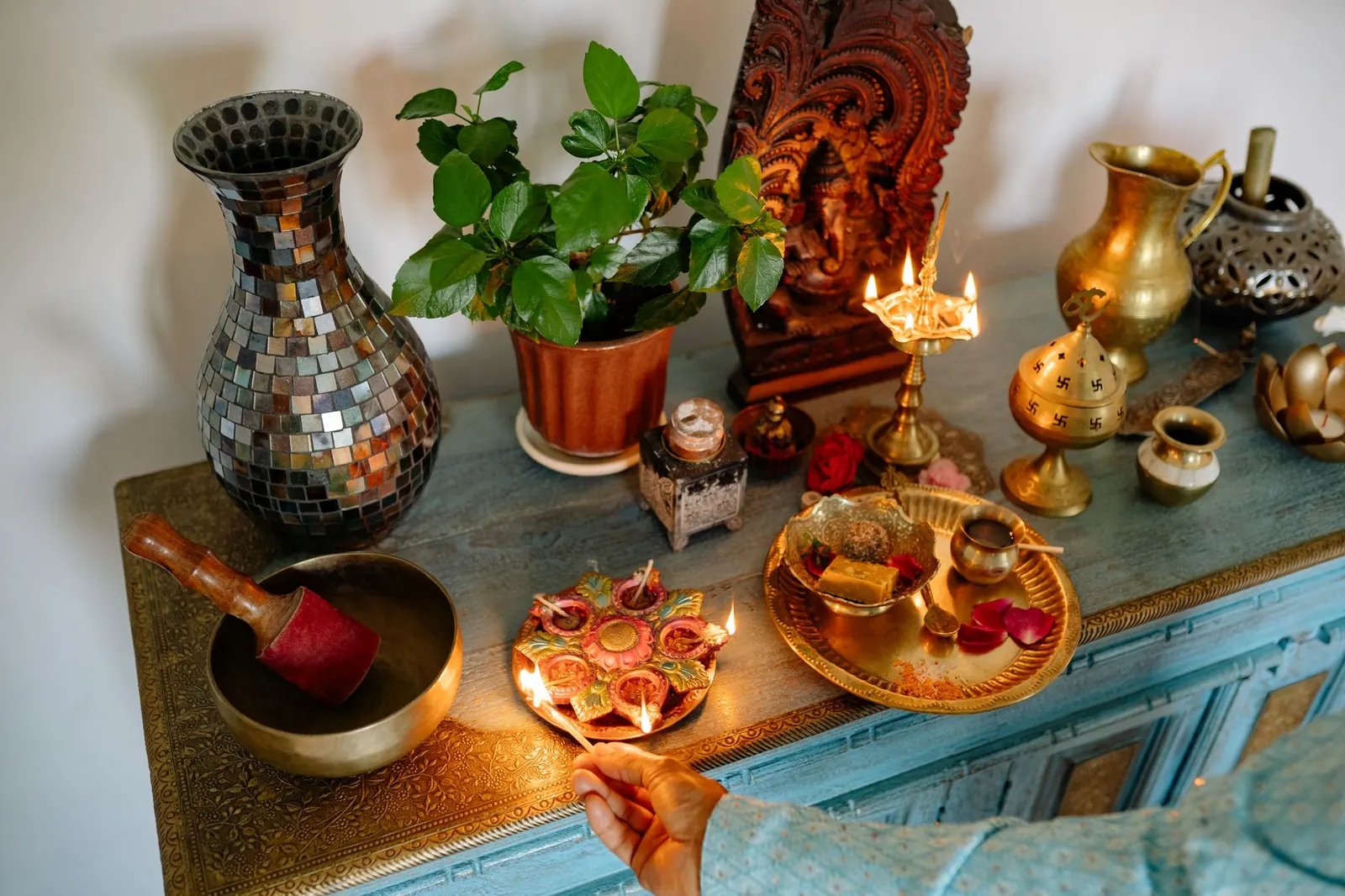
Open almost any vastu book and the puja space goes in one place: the north-east. Then open the floor plan of a typical city flat. The north-east corner can turn out to be an attached bathroom, a balcony door or the main entrance, and in an apartment block the bathrooms are often stacked in that same corner floor after floor. That gap between the book and the plan is where most worry about pooja room vastu begins, and this guide is written around it.
The tradition is less rigid than the worry. It gives the puja space, whether a whole room, a wooden mandir or a single shelf, to the north-east, the corner called Ishan; it asks you to face east or north while you pray; and it discourages a few placements. When the north-east is taken, many vastu writers accept the east or the north instead, and none of the advice needs a wall broken. Below is the puja room record from Astroliya's vastu tool, the reasoning behind each line, and a flat where the ideal corner is out of reach, checked spot by spot.
Pooja room vastu in four lines
Astroliya's free vastu guide keeps the puja room to a single short entry.
| Astroliya's puja room record | |
|---|---|
| Traditionally preferred zone | North-east (Ishan corner) |
| Which way you face | East or north while praying |
| Keep | The space clean, simple and well lit; a small diya in the morning if you like |
| Avoid | A puja space under a staircase; sharing a wall with a bathroom; broken idols or torn pictures |
The rest of this page is commentary on those four lines. Notice what the record leaves out: no colours, no materials, no size for the room.
Why vastu gives the puja room the north-east
Vastu texts divide a home into directions, each with a presiding deity and a character. The north-east is named after Ishana, a form of Shiva, and the tradition treats it as the most sacred and the "lightest" corner of the house. Classical layouts keep it open, clean and free of heavy things, which is why it is the traditional choice for worship, and why vastu writers object so strongly to a toilet or a storeroom there.
There is also a practical reading that many people find helpful. The sun rises in the east, so a north-east corner is often one of the brightest and calmest spots in the morning, which is exactly when most households light a lamp and pray. Whether you take the north-east as sacred geography or simply as the corner with good morning light, the advice lands in the same place.
If the north-east is not available
Second choices differ between vastu writers. Many accept the east or the north for a puja space when the north-east is taken by a staircase, a bathroom or the main door. Astroliya's record names only the north-east, so treat east or north as a reasonable fallback rather than a rule. For how the other rooms share out the directions, see vastu shastra for home, which puts every room on one plan.
Puja room direction as per vastu: which way you face
People often mix up two questions: where the puja space sits in the house, and which way you face when you sit before it. The second matters more in daily practice, because it is what you actually do every morning.
Astroliya's record says to face east or north while praying. The idols or pictures then face the opposite way, towards you.
| You face | The idols face | What the tradition associates with it |
|---|---|---|
| East | West | The rising sun; the most widely recommended choice |
| North | South | The direction of Kubera and the pole star; commonly accepted |
| West or south | East or north | Not the usual advice; many households avoid it |
Here vastu guides disagree, and it is better to say so than to pretend otherwise. Some prefer that idols never face south, which rules out the "you face north" row. Others accept it without comment. If you have a choice, facing east satisfies every version of the advice. If your layout only allows you to face north, the tradition as Astroliya records it is comfortable with that too.
Idol height and placement
Classical texts say much less about idol height than modern vastu articles do, so take the points below as common household practice, not fixed rules.
- Keep idols off the floor. Most families place them on a raised platform, a wooden chowki or the shelf of a mandir.
- A comfortable eye line. A common rule of thumb is that when you sit or stand to pray, the deity should be at about the height of your chest, so that you look slightly up rather than down at it.
- A little space from the wall. Many keep idols an inch or two away from the wall rather than pressed against it, so air and light move around them and the wall stays easy to clean.
- Fewer, not more. Household guides often suggest small idols for a home shrine and not too many of the same deity. A crowded altar is harder to keep clean, and cleanliness is the one point every version of the tradition agrees on.
- Pictures count as idols. A framed picture of a deity is treated with the same care: kept straight, dusted, and replaced if it is torn or faded beyond recognition.
What happens to a broken idol? The usual custom is to remove it from worship respectfully, often by immersing it in flowing water or leaving it at a temple, rather than keeping it on the altar. Astroliya's record lists broken idols and torn pictures under "avoid" for this reason.
What tradition says to avoid
The three placements in Astroliya's avoid list are the ones vastu writers repeat most often.
Under a staircase
People walk over the space under a staircase all day, and the tradition does not want the deity below their feet. It is also, practically, a dim and dusty corner. If a mandir has always stood there in your home, moving it to a shelf elsewhere is a simple change; nothing needs demolishing.
A wall shared with a bathroom
A puja space should not share a wall with a toilet or bathroom, and it should not sit directly above or below one on another floor when that can be helped. In flats this is the most common clash, because bathrooms are often stacked in the same corner. Moving the mandir along the wall by a metre, or to the facing wall, is usually enough to satisfy the advice.
The bedroom question
Astroliya's record does not list the bedroom under "avoid", and many families in small homes keep their mandir in a bedroom. Where they do, common practice is to place it in the north-east of that room, draw a curtain or close the mandir's doors at night, and avoid sleeping with your feet pointing towards it. That is a workable arrangement, not a compromise to feel guilty about.
Pooja room in a small flat: the corner mandir
Most Indian city flats have no spare room for worship, and the tradition never assumed every home would. A pooja room in a small flat is usually a corner mandir, a wall-mounted shelf or a closed wooden cabinet. Here is a simple way to decide where it goes.
- Find the north-east of the flat. Stand near the centre of your home with a phone compass and note where north and east meet. It does not need to be precise to the degree.
- Check what is there. If it is a living-room or bedroom corner, that is your spot. If it is a bathroom, kitchen or the main door, move to the east or north wall of the nearest room instead.
- Check the other side of the wall. If a bathroom is directly behind it, shift along the wall or to another wall.
- Choose the form. A wall shelf saves floor space and keeps idols at chest height naturally; a floor-standing mandir gives you a drawer for diyas and incense; a cabinet with doors suits a bedroom or a living room where you want the shrine closed when guests are over.
- Set the facing. Arrange it so that you face east or north when you sit or stand before it.
Worked example: when the north-east is a bathroom
This is an illustration, not a real home. A family lives in a duplex flat on the top two floors of a building. Downstairs, the north-east corner is a guest bathroom, so the ideal zone is gone before they start. They have four places in mind, and each one is checked against the record rather than against a feeling.
| Candidate spot | Zone | You would face | What the record flags |
|---|---|---|---|
| The alcove under the internal staircase | North | North | Under a staircase: on the avoid list |
| A shelf on the living-room east wall | East | East | The first metre of that wall backs onto the guest bathroom |
| The upstairs bedroom's north-east corner | North-east of that room | East | Sits directly above the guest bathroom |
| The top of a closed cupboard on the study's north wall | North | North | Nothing |
The alcove is the spot that looks built for a mandir, and it is the one the record rules out. The east-wall shelf works once it is mounted a metre further along, past the bathroom. The upstairs corner is in the right part of its room but stacked over the bathroom, which tradition avoids when it can be helped. The cupboard top passes every check, though the family would face north rather than east.
They choose the living-room shelf, at chest height, a metre clear of the bathroom wall, and stand facing east to pray. Facing east is the one choice every version of the advice accepts, so the shelf wins over the cupboard. The lesson travels to most flats: the avoid list does more of the work than the compass, and the fallback directions exist precisely for homes like this one.
Mandir direction in home when you rent
Tenants often worry because they cannot change anything. You do not need to. A freestanding mandir, a shelf on existing hooks, or even a cleared top of a cupboard in the north-east is fully in the spirit of the advice. The mandir direction in home is a matter of where you set it down, not of building anything.
What to keep in the pooja space
The record keeps this deliberately short: the space clean, simple and well lit, and a small diya in the morning if you like. Beyond that, most home shrines hold a few familiar things.
- A diya or lamp, lit in the morning and, in many homes, again at dusk.
- A bell, a small water vessel and a plate for flowers or prasad.
- A japa mala, if you chant. Our guide to mantra japa rules explains how to count on a 108-bead mala, and the free mantra tool gives a mantra card and a counter.
- A yantra, if your family worships with one. A Lakshmi Yantra pyramid is a common choice in the puja corner; Astroliya's store lists a Lakshmi Yantra pyramid that comes with a free raw pyrite stone, tagged by the store for puja and vastu decor.
These are traditional objects of worship and decor. Keeping them is a matter of practice and taste; none of them is required, and none of them changes anything on its own.
Where the tradition stops
Vastu advice about the puja room is often delivered with more fear than it deserves, so its limits are worth stating plainly.
- It does mean the tradition has a preferred corner and a preferred facing, and a few habits it values: cleanliness, light and respect for the images you worship.
- It does not mean a puja space in another corner is unlucky or dangerous. Classical vastu describes ideals; it does not threaten households that cannot meet them.
- It does not mean you should rebuild, break walls or move house. Every suggestion on this page can be followed with a shelf and a compass.
- It is not a substitute for medical, legal or financial advice. If something in your life is going wrong, a mandir's position is not the place to look first.
Devotion does not depend on a direction. The tradition offers the north-east as the best setting it knows, and most families simply do what their home allows.
See it for your own home
Astroliya's free vastu by room page shows the puja room's zone with the direction lit on a compass, beside the same keep and avoid list as above, and the entrance, kitchen, bedroom and study alongside it. If you want to talk through your own floor plan, you can ask Astroliya's AI astrologer in chat. It can explain what the tradition says; for anything structural, such as moving plumbing or a wall, ask an architect or engineer.
Puja room questions
Can the pooja room be in the bedroom?
Astroliya's record does not rule it out, and many small homes do this. Common practice is to keep the mandir in the bedroom's north-east, close its doors or draw a curtain at night, and not sleep with your feet towards it.
Is a mandir under the stairs bad?
Vastu tradition advises against it, mainly because people walk over the space and it is usually dark and dusty. It is not a reason for alarm; moving the idols to a wall shelf in the north-east or east is a simple fix.
Which way should the idols face?
If you face east while praying, the idols face west; if you face north, they face south. Some vastu guides prefer that idols never face south, so facing east is the choice every version of the advice accepts.
What if the north-east of my flat is the bathroom?
Then use the east or north wall of another room, and make sure no bathroom shares the wall behind the mandir. Vastu writers widely accept this, and nothing about it needs building work.
Do I need a separate pooja room?
No. A shelf, a corner mandir or a small cabinet in the right corner follows the tradition just as well. What the advice asks for is a clean, well-lit, respectful space, not a dedicated room.
From the Astroliya store
Pieces for this guide
Chosen from our own store to go with what you just read.
 45% off7 Horses Raw Pyrite Vastu Frame for Wealth, Success & Career Growth₹549
was ₹999Buy 10% offLakshmi Yantra Pyramid with Free Raw Pyrite Stone for Wealth & Prosperity₹899
was ₹999Buy 53% offASTROLIYA 7 Trunk Elephant Pyrite Wall Frame for Wealth & Prosperity₹699
was ₹1,499Buy Authentic 5 Mukhi Rudraksha Mala - 108 Beads for Meditation₹1,260.60Buy